

Faults
Short circuits, RCDs that trip, sockets that don’t work. The same-day call.
Faults, electrical certificates and installations. A visible phone number for emergencies and a catalogue of jobs with prices for the work that’s planned.
Free until your first customer or 6 months · No card · No commitment · Live in minutes
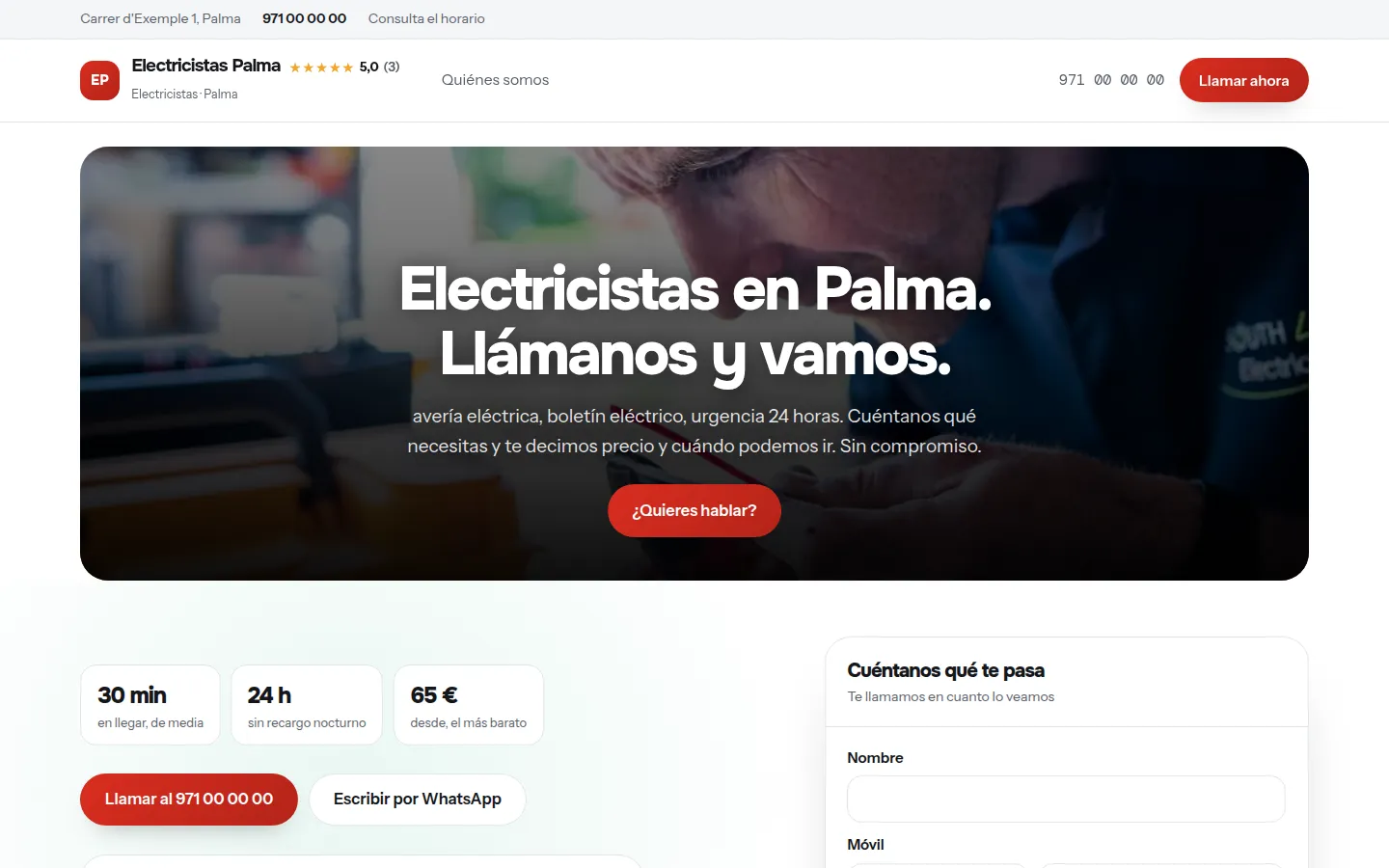
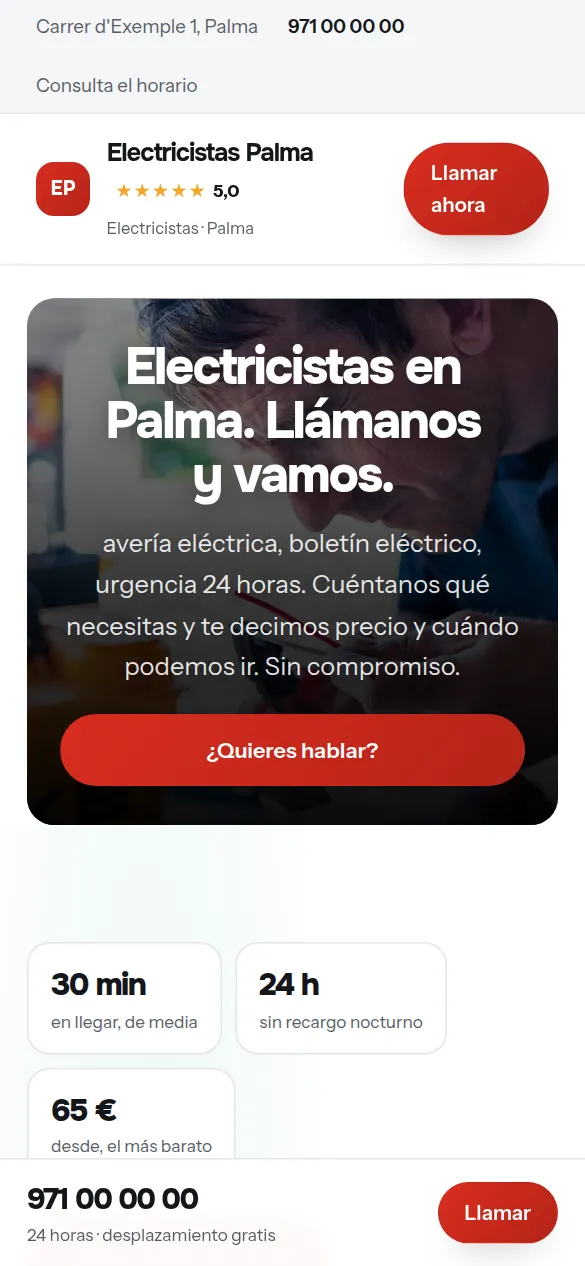
You pick electricians from the list, your website’s name and your phone number, and the website is created with what a business like yours offers (electrical fault, electrical installation certificate and 24-hour emergency call-out), which you replace with your own from the dashboard.
Thirty-six designs and your colour, with your electrician website alongside while you choose. When you finish, it is already live.
With their name and their website, so you can check. Translated from Spanish.
“Simple, clear and made for people who are not tech-savvy. In two days we had the website with opening hours and phone number. Customers use it a lot.”
 Mihaly SimoCerrajería Artesanal
“I used to miss a lot of calls because I was on a job. Now customers book from the website at any time and I just check my phone when I can. Very easy to set up.”
 Esteban JiménezCerrajería Jiménez e Hijos
A fuse box that keeps tripping, a certificate to get the electricity connected and a complete installation are three different jobs. Each one is searched for by its exact name.
Short circuits, RCDs that trip, sockets that don’t work. The same-day call.
The electrical installation certificate (boletín) needed to get the power connected. With a deadline and in a hurry: searched for a huge amount, by its own name.
Homes, shops, new builds. A big quote and a decision made after comparing.
Replacing the consumer unit, increasing the contracted power, bringing it up to regulations. Very common in older flats.
Switching to LED, light points, outdoor lighting. Small jobs with a good margin.
Installation, paperwork and grants. It’s what has grown most and where there’s least competition.
Maintenance, inspections, emergencies. Contracts that renew themselves.
Nobody types “website” when they need electricians: they search for what they need, with their own words. These are the ones that bring work to a website like yours.
Whoever needs electrical fault or electrical installation certificate calls you, messages you on WhatsApp or asks through a form that asks what is needed and where.
Three very different kinds of job: the certificate is paperwork, the fault is an emergency and the installation is a project.
With a fixed price and a timescale. It’s the most profitable search and the one fewest websites answer.
Phone and WhatsApp at the top, no forms.
With a quote beforehand and a bookable visit.
Your installer number is what lets you sign certificates. Put it on.
If you handle the paperwork with the industry department and the electricity company, say so: it saves the customer work.
How many years and what it covers.
People look for an electrician for two very different reasons: because the power has gone or because they need a certificate. Your website has to make clear that you do both and what each one costs.
It’s paperwork with a known price and huge search volume. Putting it on its own page catches people who are getting their electricity connected.
Saying what the first hour costs and what it covers avoids the haggling call.
A photo of the fuse box tells you more than ten minutes on the phone.
An electrician gets two kinds of job: the planned kind — a certificate, a charging point — and the kind that can’t wait. The website has to work for both without you being glued to the phone.
“How much does an electrical installation certificate cost”, “install electric car charging point”: searches by someone who already needs the job done. Each service with its guide price and your installation company number in plain sight.
Someone without power searches on their phone. Phone and WhatsApp up front and your emergency hours clear, with the surcharge if there is one.
The form asks what the job is and where, and it reaches your phone instantly. You arrive knowing what materials to bring, or you give a rough price without leaving where you are.
These are not drawings: it is the sample website for electricians, live right now, and you can switch design with one click without losing anything you have written.
Some look for it as management software for electricians, others as a services website and others as online quotes: here it is the same thing.
Your website live at electricistas.agendra.digital, with your services, your opening hours and your contact form, with no card, for 6 months or until your first customer.
Your electrician website with your own domain, on Google, with Agendra AI and marketing every week. Everything included and no commitment.
If you are torn between this, a custom-built electrician website or sticking to social media: what each option costs and what it gives you.
Yes, as a service with a fixed price. It’s a standard job and publishing the rate brings you direct work.
Yes, in the header, in the about section or in the footer. It’s a strong argument, and for some jobs you’re required to identify yourself.
For receiving them properly, yes: each request arrives with the type of job and the address, by email and on your phone, and you have them all in the dashboard. It doesn’t calculate quotes or issue certificates: that’s still your job and your software.
Yes: the 24-hour emergency is one service, with its price, and the certificate or the installation are others. On the website they appear separately: someone with an emergency calls, and someone asking for a certificate writes to you calmly through the form.
Yes. You set 24-hour opening times and the website shows the phone number with a tap-to-call button, with no calendar getting in the way.
Yes: /electrical-certificate or /electric-car-charger-installation are specific searches with a lot of intent.
Yes. Create a dedicated page for maintenance of shops and residents’ associations, with contract rates.
On a quote portal like Habitissimo or Cronoshare (Spanish platforms where customers request quotes from tradespeople), the request for an electrical certificate usually goes to several professionals at once, and the customer compares prices before getting to know you, on the platform’s terms. On your website, whoever calls or writes to you has already chosen you, and you pay a fixed monthly price, without paying per contact. It’s not one or the other: you can stay on the portal while your website starts bringing you customers of your own.
Yes. From the dashboard you add real reviews from your customers, with their permission, and they appear with their stars on every page of your website, with the average rating next to your name. They can’t be made up and they aren’t pulled in from Google automatically: what gets published is what people have really told you.
Faults, electrical certificates and installations. A visible phone number for emergencies and a catalogue of jobs with prices for the work that’s planned.
Free until your first customer or 6 months · No card · No commitment · Live in minutes