


Equipment Pilates
Reformer, Cadillac, tower. Small groups and a higher price: it’s worth explaining why.
Equipment, mat and small groups. A business where every reformer is a place and where controlling capacity means controlling the business.
Free until your first customer or 6 months · No card · No commitment · Live in minutes
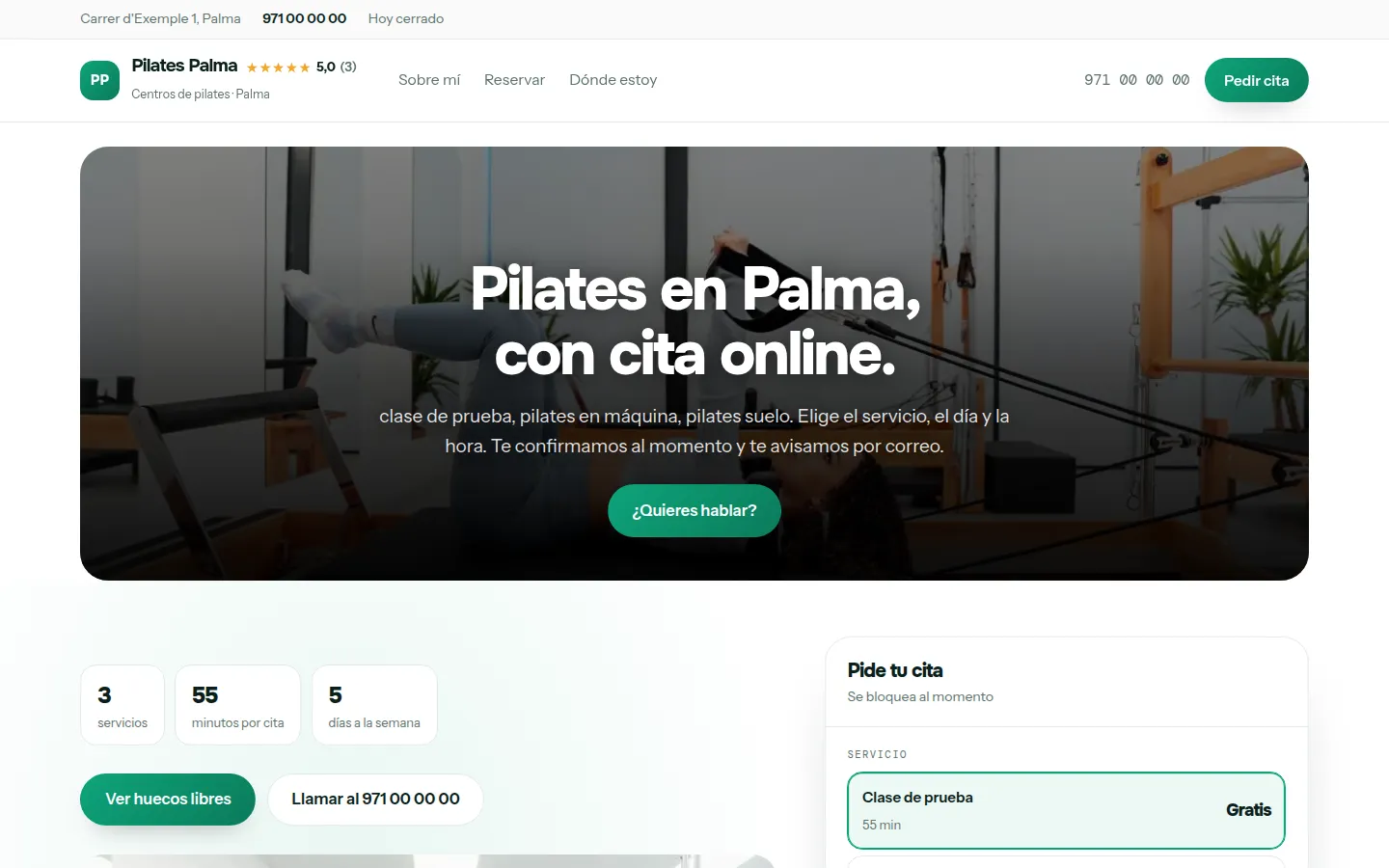
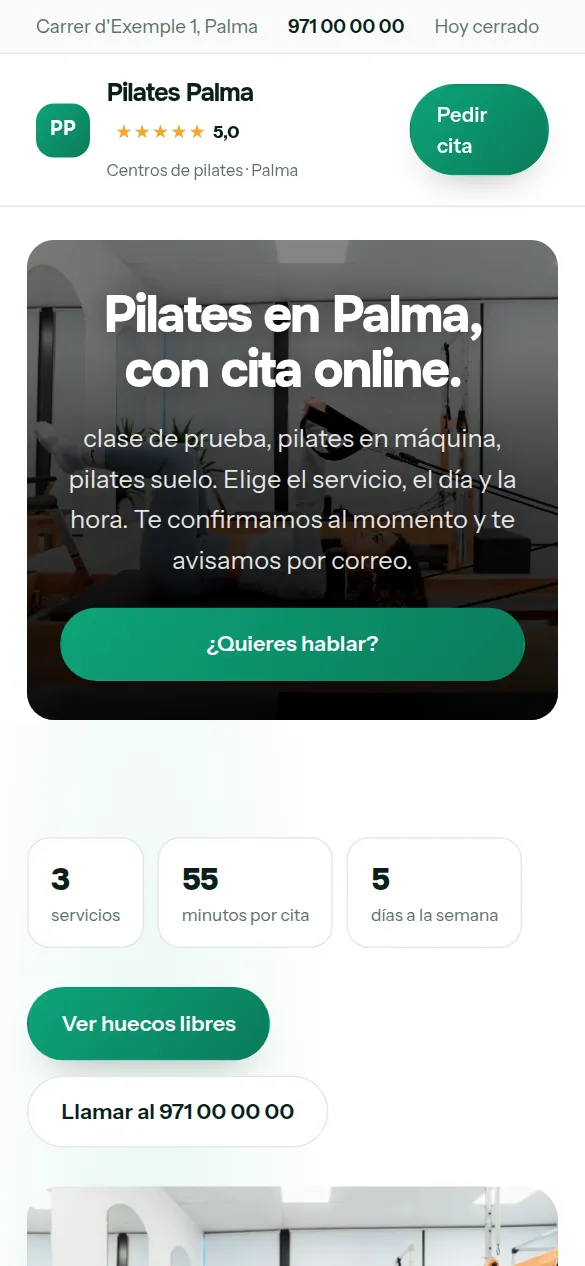
These are not drawings: it is the sample website for Pilates studios, live right now, and you can switch design with one click without losing anything you have written.
Some look for it as an online booking calendar for Pilates studios, some type “create a website with online bookings” and some search for “appointment software”: here it is the same thing.
It works just the same if your business is called Pilates centre, Pilates studio, reformer Pilates or equipment Pilates: it is the same software and the same website.
There are no reviews from Pilates studios on Agendra yet: have a look at other customers’ websites.
You pick Pilates studios from the list, your website’s name and your phone number, and the website is created with what a business like yours offers (trial class, equipment Pilates and mat Pilates), which you replace with your own from the dashboard.
Thirty-six designs and your colour, with your Pilates studio website alongside while you choose. When you finish, it is already live.
Equipment and mat are two businesses with very different prices, and many people don’t even know both exist. Explaining it is what raises the average ticket.
Reformer, Cadillac, tower. Small groups and a higher price: it’s worth explaining why.
In a group, more affordable. The natural way in for those trying it out.
How many people per class. It’s your best argument against a gym.
Back, pelvic floor, postnatal, rehabilitation. Searched for a lot and often referred by physios.
Which class has places this week. In small groups, the place is the product.
One, two or three classes a week. With what each option costs.
If you do a first assessment session, say so: it justifies the price and filters well.
This is the dashboard of your Pilates studio website, with a full calendar.

With six machines you can’t have seven people. In Pilates, capacity isn’t a recommendation: it’s a physical limit.
Publish the group size: it’s an argument against gyms.
Reformer, Cadillac, mat. Each option with its price.
Compulsory in many studios, with its price and duration.
Eight or twelve sessions with an expiry date.
Two or three days a week, which is the usual format.
More expensive and very profitable, for injuries or rehabilitation.
In Pilates, capacity isn’t a recommendation: there are four machines. Management software that doesn’t count places is no use to a reformer studio.
Four on reformer, ten on the mat. Each class with its real capacity and its price.
Most students always come at the same time. They book once and it stays.
A one-to-one appointment beforehand, which is also the one that turns a trial into a monthly membership.
What takes up the most time in an appointment business isn’t the work: it’s juggling times by phone and WhatsApp, and the slot left empty because someone didn’t turn up. With each service in its slot — a 55-minute trial class and 55-minute equipment Pilates — and a reminder before every appointment, both weigh far less.
Your website answers what your students type before choosing — “Pilates classes for beginners”, for example — and booking is one tap away. The day after each appointment, an email asks for their review, which is what counts most for the next person.
Each service with its duration and price on show — a 55-minute trial class and 55-minute equipment Pilates — and the diary offering only what fits. WhatsApp is left for your students’ questions, not for finding a slot.
People who can’t come let you know when it only takes a click, and the reminder the day before puts it right in front of them. On each appointment you see which of your students have confirmed and who hasn’t replied yet.
Nobody types “website” when they need Pilates studios: they search for what they need, with their own words. These are the ones that bring work to a website like yours.
Your students choose trial class or equipment Pilates, a day and a time, and the slot is blocked in your calendar automatically.
Your website live at pilates.agendra.digital, with your services, your opening hours and your bookings, with no card, for 6 months or until your first customer.
Your Pilates studio website with your own domain, on Google, with Agendra AI and marketing every week. Everything included and no commitment.
If you are torn between this, a custom-built Pilates studio website or sticking to social media: what each option costs and what it gives you.
Yes. Each class has its places — four on reformer, ten on the mat — and its fixed times in the week. Places are booked one by one from the website and, when they run out, it stops being offered.
Yes, they’re different services or products with different prices. The one-to-one is usually the most profitable service.
Yes, for group classes too. Each class has its places and its fixed times in the week — Monday and Wednesday at 19:00, for example — and each person books their place from your website seeing how many are left. When it’s full, it stops being offered. One-to-one sessions — the trial class, a private class — are booked in the free slots of your timetable, and no single appointments are offered at the time of a class.
You can create it as a service and explain in the others that it has to be done first. The system doesn’t enforce it automatically.
Yes, by publishing them as a product with their monthly price. Automatic recurring payments aren’t available yet; for now that’s handled with you.
Yes, and it’s worth keeping separate: it’s a different audience, a different search and a different price.
Yes, it isn’t one or the other. Pass apps bring people who are trying out studios, on the app’s terms. Your website is where people who have already chosen you book: with your timetable and your prices, for a fixed monthly price and with no paying per class. The more people come through your website, the less you depend on the app.
Google Maps is fed by your Google Business Profile, which you set up yourself, for free, and where you add your website. If you work without premises, in that profile you can hide your address and mark the areas you cover; if you only work remotely or only sell online, Google doesn’t allow a listing on the map and what brings you customers is the website itself. The website carries your opening hours and services in the format Google reads, and it appears on Google on the free Trial plan too. With the Professional plan we register it in Search Console and you get a page for each town where you work. Nobody can guarantee you a position: if someone promises you one, be wary.
Equipment, mat and small groups. A business where every reformer is a place and where controlling capacity means controlling the business.
Free until your first customer or 6 months · No card · No commitment · Live in minutes