


What you help with
Anxiety, depression, grief, couples therapy, child psychology, eating disorders. Written the way someone who is struggling would write it, not like a textbook.
A calm, sober practice website, with no promises of a cure and no sensitive data involved: explain your approach and your fees, and let patients book their first session without having to call.
Free until your first customer or 6 months · No card · No commitment · Live in minutes
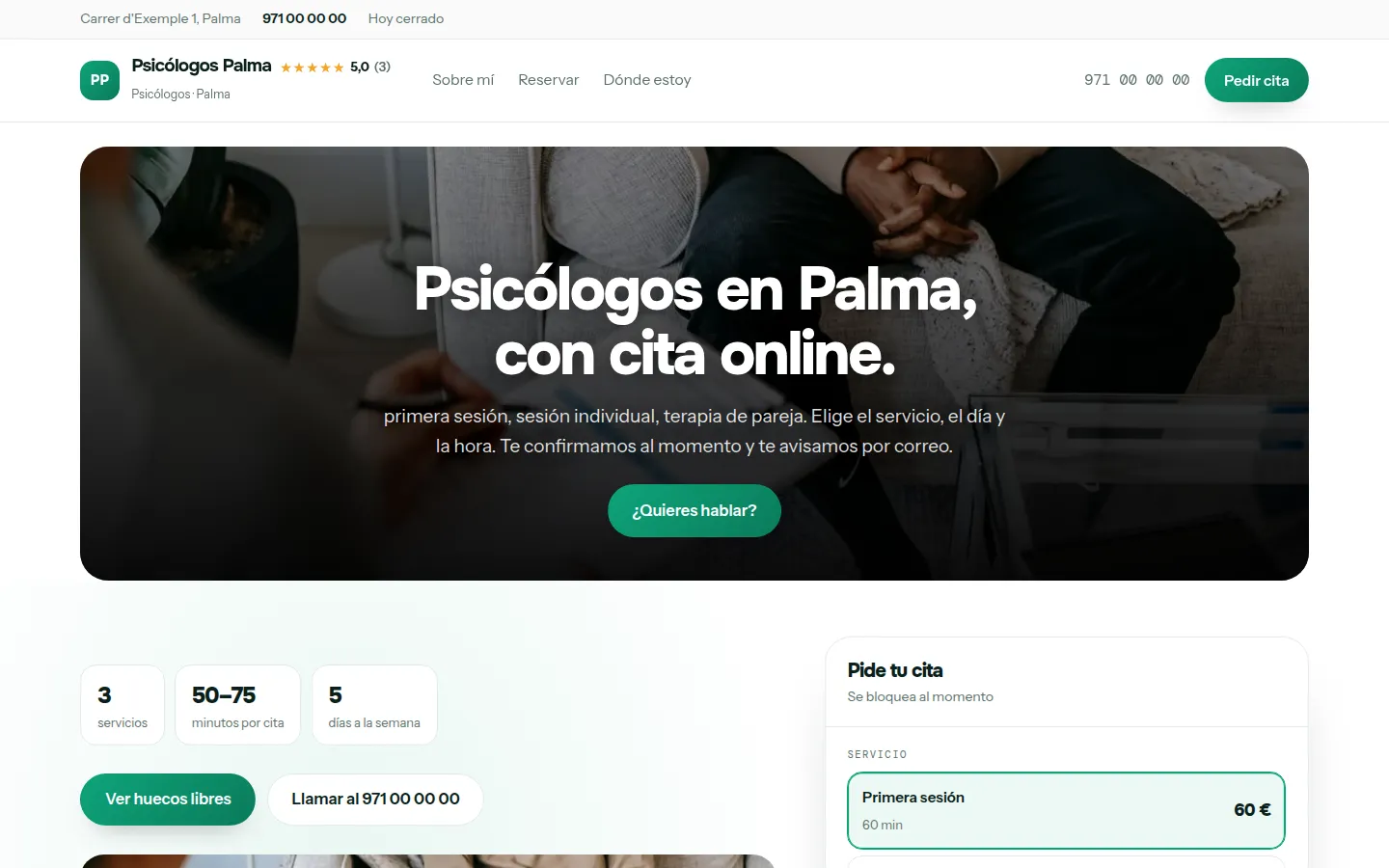
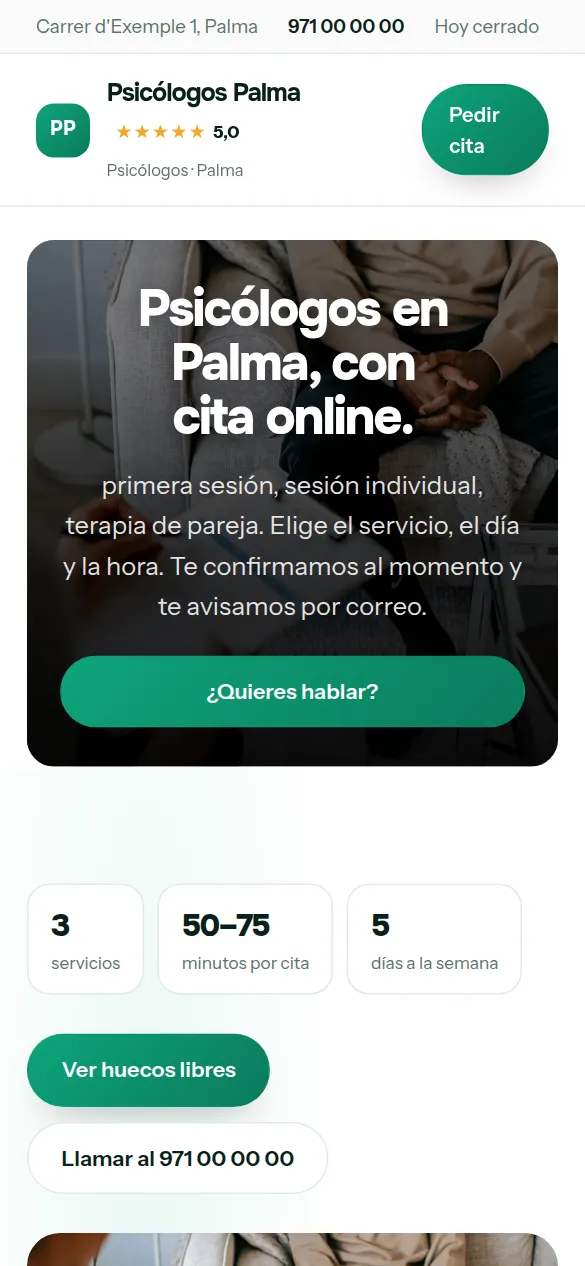
These are not drawings: it is the sample website for psychologists, live right now, and you can switch design with one click without losing anything you have written.
Some look for it as an online booking calendar for psychologists, some type “create a website with online bookings” and some search for “appointment software”: here it is the same thing.
It works just the same if your business is called psychology practice or psychology consultancy: it is the same software and the same website.
There are no reviews from psychologists on Agendra yet: have a look at other customers’ websites.
You pick psychologists from the list, your website’s name and your phone number, and the website is created with what a business like yours offers (first session, individual session and couples therapy), which you replace with your own from the dashboard.
Thirty-six designs and your colour, with your psychology practice website alongside while you choose. When you finish, it is already live.
Choosing a psychologist takes weeks. What shortens that decision isn’t a list of techniques: it’s understanding what you help with, how you work and what it costs, without having to write an email to find out.
Anxiety, depression, grief, couples therapy, child psychology, eating disorders. Written the way someone who is struggling would write it, not like a textbook.
Two separate services, each with its own price and length. Video sessions are what break down the distance barrier, and the ones most searched for from outside your city.
Cognitive behavioural, systemic, EMDR, humanistic. No jargon: what you’ll do in the first session and what they can expect from the ones after.
In psychology it’s the first thing people who know how to search look at, and what separates you from unregulated coaching.
Fifty minutes, sixty, a pack of four. Saying it saves the awkward call and filters out people who can’t afford it.
Articles about what you treat. In psychology it’s what brings the most traffic: people read three articles before booking their first appointment.
This is the dashboard of your psychology practice website, with a full calendar.

People looking for a psychologist often take weeks to make up their mind. When they finally do, a clear website and a booking button count for more than any argument.
Lots of people book their first appointment in the small hours, precisely because they don’t want to explain themselves on the phone.
Cognitive behavioural, systemic, EMDR or couples therapy: explain it without jargon and without promising results.
The fee per session is the first question and the one people least dare to ask. Put it up and you save yourself filtering enquiries.
50 minutes in person, 50 online, a 75-minute couples session. Each with its own price and length.
Stops people booking you for twenty minutes’ time when you’re with another patient.
Mark one-off closures and holidays; those days disappear from the calendar.
The booking asks for name, phone and email. No history and no reason for the visit: that’s discussed in session.
The database is in Ireland and the connection is fully encrypted.
Every website comes with its privacy page, with your details as the data controller.
Practice management software for a psychology practice has a requirement the others don’t: what happens in session can’t end up in a form. Here people book an hour, not a case history.
50 in person, 50 online, 75 for couples. Each with its own price and length, and the calendar works out the slots with the right one.
Name, mobile and little else. We don’t ask for the reason for the visit or any background: these are special-category data under GDPR and aren’t needed to give an appointment.
Minimum notice for booking, an email to the patient and one-click cancellation from that same email, so the slot is free again.
Booking a psychologist is harder than booking a hairdresser. The design of a psychology practice’s website has to lower that barrier: who you are, how you work, what it costs, and a way to book without having to explain anything on the phone.
Your photo, your training, your registration number and the areas you work in: anxiety, couples, children and teenagers. It’s what people look at before deciding.
Each format with its own price. For online sessions, your Google Meet, Zoom or Teams link goes automatically in the appointment email.
A page for each area and each place where you see patients, and a blog to answer what people ask you, on your own domain.
Booking a psychologist is hard: lots of people decide at night and don’t want to explain on the phone. Online booking that doesn’t ask the reason, just a name and contact details, removes that barrier and saves you calls in the middle of a session.
People who search for “psychologist that accepts health insurance” or whether online therapy works compare several websites before deciding. Explain what the first session is like, what it costs and whether you see people online, and put the booking one tap away: that’s where the decision gets made.
A one-hour first session, 50-minute individual sessions, 75 for couples: each with its own price. If it’s by video call, the link goes in the confirmation email and you don’t have to send it yourself.
The day before, a reminder with a button to confirm, change or cancel, and any slot that frees up goes back into the diary. If you charge for sessions not cancelled in time, your policy is written in the same message you use to request payment.
Nobody types “website” when they need psychologists: they ask Google about prices, urgency and trust. Answer that, and the website does the selling.
Your patients choose first session or individual session, a day and a time, and the slot is blocked in your calendar automatically.
Your website live at psicologos.agendra.digital, with your services, your opening hours and your bookings, with no card, for 6 months or until your first customer.
Your psychology practice website with your own domain, on Google, with Agendra AI and marketing every week. Everything included and no commitment.
If you are torn between this, a custom-built psychology practice website or sticking to social media: what each option costs and what it gives you.
Yes. They’re set up as two separate services, each with its own length and fee. The patient chooses when booking and you see it in the diary.
The database is hosted in the European Union and the website runs on HTTPS. The booking only asks for name, phone and email: no health data, which is special-category data under GDPR.
Yes. The online session is just another service, with its own length and price, and the video call link —Meet, Zoom or whatever you use— goes in the confirmation email. The booking asks for name, phone and email, not the reason for the visit: that’s discussed in session, not in a form.
The reminder the day before lets them confirm or cancel with one click, and on each appointment you can see who has confirmed and who hasn’t replied. You can set a minimum notice for bookings and, if you work with payment in advance, request it by Bizum (Spain’s instant bank-to-bank mobile payment) or bank transfer from the appointment itself. If you connect your Stripe account, they can also pay by card when booking.
Yes. You add a one-off closure for that day or those hours and they stop being offered.
You can put it wherever you like: in the header, in “about me” or in the footer. Your registration number builds trust and many patients look for it.
Yes, the website includes a blog. Each article has its own address that can appear on Google and bring you patients who were looking for information, not yet for a psychologist.
Yes. There’s no automatic connection with insurers, but you can say on your website which ones you work with —Sanitas, Adeslas, DKV, Asisa…— and add the question “Are you coming through your insurance? Which one?” to the booking form so you know before the appointment.
On a directory you appear in a list next to other psychologists in your area, with the platform’s design and terms. With Agendra you have your own website, with your own domain if you connect it, your diary and your patients, for a fixed monthly price and without paying per appointment. It isn’t one or the other: you can keep your directory profile and link from there to your website, where patients book directly with you. We go through it calmly in Doctoralia or Agendra.
Yes. It’s set up as a service with its own length and a price of zero, and on the website it shows as “Free”. For many patients it’s what makes them take the first step.
No. Agendra doesn’t issue invoices or send anything to the tax office (Hacienda), so Verifactu (Spain’s system for reporting invoices to the tax office) stays with your usual invoicing software or your gestoría (an administrative and tax agency). What you do get is a record of what was paid on each booking and a CSV download of bookings and clients to pass to whoever does your accounts.
A calm, sober practice website, with no promises of a cure and no sensitive data involved: explain your approach and your fees, and let patients book their first session without having to call.
Free until your first customer or 6 months · No card · No commitment · Live in minutes