


Your treatments, one by one
Manual therapy, dry needling, therapeutic exercise, pelvic floor, sports rehab or lymphatic drainage. Each with its own length and price, because an assessment doesn’t take as long as a follow-up.
Your clinic online in an afternoon: treatments, prices, split opening hours and a calendar where patients book their session without calling you between treatments.
Free until your first customer or 6 months · No card · No commitment · Live in minutes
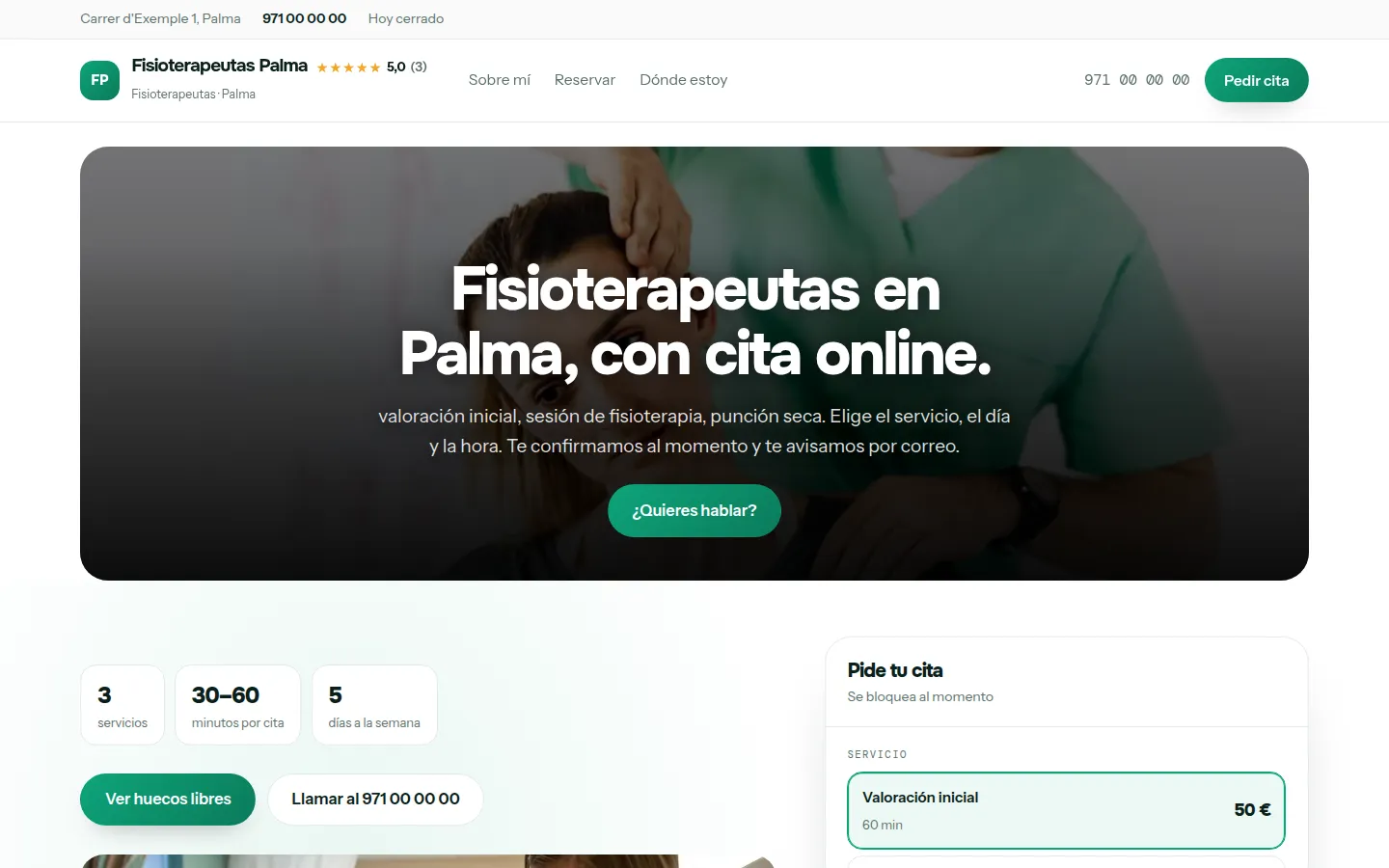
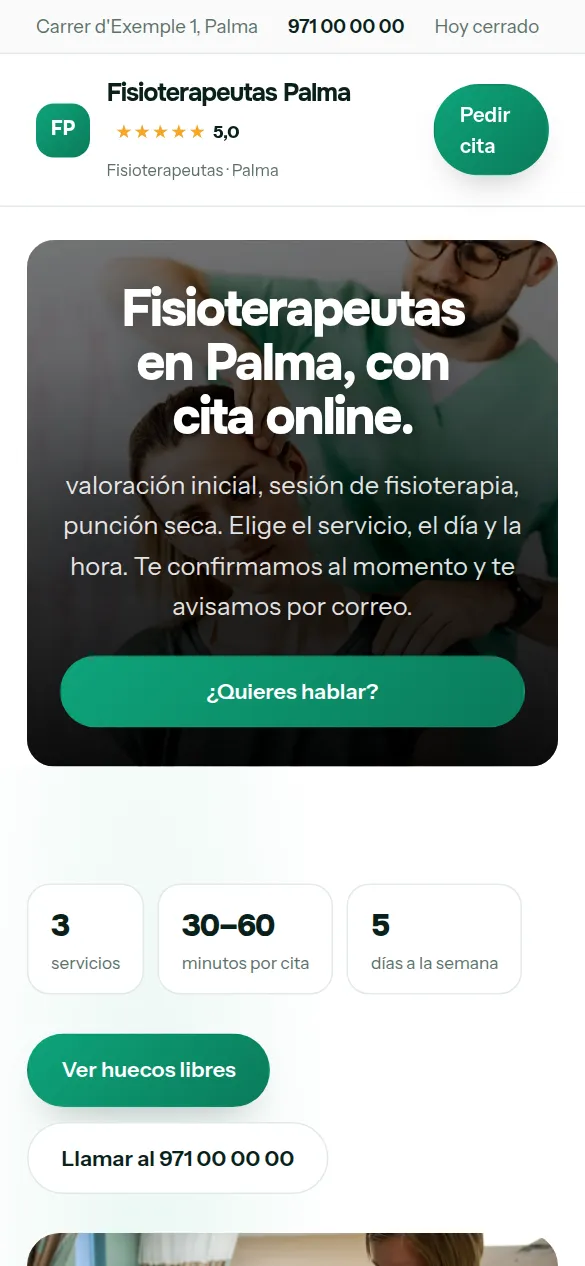
These are not drawings: it is the sample website for physiotherapists, live right now, and you can switch design with one click without losing anything you have written.
Some look for it as an online booking calendar for physiotherapists, some type “create a website with online bookings” and some search for “appointment software”: here it is the same thing.
It works just the same if your business is called physiotherapy centre, physiotherapy clinic or physiotherapy: it is the same software and the same website.
There are no reviews from physiotherapists on Agendra yet: have a look at other customers’ websites.
You pick physiotherapists from the list, your website’s name and your phone number, and the website is created with what a business like yours offers (initial assessment, physiotherapy session and dry needling), which you replace with your own from the dashboard.
Thirty-six designs and your colour, with your physiotherapy website alongside while you choose. When you finish, it is already live.
People looking for physio aren’t looking for “a physiotherapist”: they want their shoulder fixed, or their pelvic floor after giving birth. The more specific you are, the fewer people ring to ask whether you treat their problem.
Manual therapy, dry needling, therapeutic exercise, pelvic floor, sports rehab or lymphatic drainage. Each with its own length and price, because an assessment doesn’t take as long as a follow-up.
A single session, a pack of five and a pack of ten. It’s the question people ask most on the phone, and the one people who can’t see it written down simply don’t ask.
Your training, your years in practice and what you specialise in. A clinic with a name and a face converts far better than one without.
A small detail that separates a physiotherapy clinic from an unqualified massage. It goes on your website and on your Google profile too.
Address, map, parking and public transport. It’s what people check on their phone on the way to the appointment.
If you visit patients at home, say so, with the area you cover and the travel charge: people search for it specifically and hardly anyone works on it.
This is the dashboard of your physiotherapy website, with a full calendar.

A first visit doesn’t last as long as a follow-up, and at lunchtime the couch is empty because you’re eating, not because there’s a free slot.
A 60-minute initial assessment, a 45-minute follow-up, 30 minutes of dry needling. Each service works out its own slots.
Mornings and afternoons set separately. The 14:30 slot doesn’t show as booked: it simply doesn’t exist.
Ten or fifteen minutes to change the couch, air the room and note down progress before the next one.
Manual therapy, dry needling, therapeutic exercise or pelvic floor, each with its price and length.
Address, phone and opening hours visible on a phone, which is where people search for a clinic nearby.
A small detail that separates a serious clinic from an unqualified massage.
Patients book at eleven at night, when their back hurts, not when you can pick up the phone.
Every booking reaches your email and your phone calendar, and the patient gets their confirmation.
If they can’t come, they cancel from their email and the slot is free again for someone else.
Practice management software for physiotherapy isn’t a calendar with your logo on it. It’s knowing that an assessment takes 60 minutes and a follow-up 45, that you have to change the couch between patients, and that you don’t eat lunch with your phone in your hand.
Patients book from their phone whenever their back hurts. You see the day’s diary when you open the dashboard, and every booking also goes into your Google Calendar.
Manual therapy, dry needling, pelvic floor or rehab: each one works out its own slots. Changing a price is one field, not a call to whoever built your website.
The WhatsApp button takes the patient to your number with the message already started, and anyone who’d rather not talk books on their own. Both routes end up in the same diary.
Web design for physios isn’t about animations: it’s about someone in pain knowing within ten seconds what you treat, what a session costs, where you are and when you have a slot.
Dry needling, pelvic floor, sports rehab: each with its own page, because that’s how patients search for it on Google.
Thirty-six looks to choose from plus your brand colour, all with the book and call buttons always to hand on the phone.
On the Professional plan, your own domain and a page for each neighbourhood or town your patients come from.
In a physio clinic the phone always rings just when your hands are on someone’s back. With online booking, the patient picks an assessment or a session, sees the slots where it fits and books without interrupting you; you see it when you finish.
Someone with lower back pain searches for “physiotherapist near me” or the price of a session without insurance. If your website answers that —prices, the insurers you work with, where you are— and they can book right there, the appointment is yours, not the next result’s.
The one-hour assessment and the 45-minute session work out their own slots, with whatever gap you need to change the couch. Patients mid-treatment book their next sessions from their phone instead of calling you for each one.
The day before, they get a reminder by email and WhatsApp with a button to confirm, change or cancel, and the minimum notice stops bookings for an hour’s time. If someone cancels, that slot is offered again on its own.
Nobody types “website” when they need physiotherapists: they type the problem, the price or the town. These are the searches your website has to answer.
Your patients choose initial assessment or physiotherapy session, a day and a time, and the slot is blocked in your calendar automatically.
Your website live at fisioterapeutas.agendra.digital, with your services, your opening hours and your bookings, with no card, for 6 months or until your first customer.
Your physiotherapy website with your own domain, on Google, with Agendra AI and marketing every week. Everything included and no commitment.
If you are torn between this, a custom-built physiotherapy website or sticking to social media: what each option costs and what it gives you.
Yes. Each service has its own length and price, and the calendar works out the slots using that length. A 60-minute assessment and a 45-minute follow-up never overlap.
You set two shifts on the same day, for example 9:00 to 14:00 and 16:00 to 20:00. The time in between doesn’t exist for the calendar, so nobody can book it.
Yes. Each treatment is a service with its own length and price —assessment, session, dry needling— and the diary only offers the slots where each one fits. Appointments people ask for by phone go into the same diary, which you carry on your phone. If several of you see patients at the same time, each diary goes on its own website: the Studio plan gives you up to five on a single invoice.
By answering on your website what a patient looks for before choosing —the price of a session, insurers, where you are— and letting them book there and then, which is usually at night. The day after each appointment, an email asks for their review with a link to your website. Your website appears on Google from the free plan, and with your own domain on the Professional plan; nobody can guarantee you a ranking.
Yes. You set the deposit amount on each service, the patient sees it before booking and you request it from the appointment itself by Bizum (Spain’s instant bank-to-bank mobile payment) or bank transfer: a WhatsApp opens with the amount and reference already written. If you connect your Stripe account, they can also pay by card when booking.
Yes. From the dashboard you create a private calendar address and add it to Google Calendar, iPhone Calendar or Outlook. Appointments appear there on their own.
Yes. You leave the address blank and use the website to explain the area you cover, your prices and the travel charge. Patients book in the same way.
On a directory you appear in a list next to other physiotherapists in your area, with the platform’s design and terms. With Agendra you have your own website, with your own domain if you connect it, your diary and your patients, for a fixed monthly price and without paying per appointment. It isn’t one or the other: you can keep your directory profile and link from there to your website, where patients book directly with you. We go through it calmly in Doctoralia or Agendra.
Your clinic online in an afternoon: treatments, prices, split opening hours and a calendar where patients book their session without calling you between treatments.
Free until your first customer or 6 months · No card · No commitment · Live in minutes