


Chiropody
The maintenance appointment: hard skin, corns, nails. It’s the one repeated most and the one that fills the diary between long treatments.
Chiropody, gait analysis, ingrown toenails and insoles: each treatment with its real length and price, and a calendar that doesn’t get it wrong.
Free until your first customer or 6 months · No card · No commitment · Live in minutes
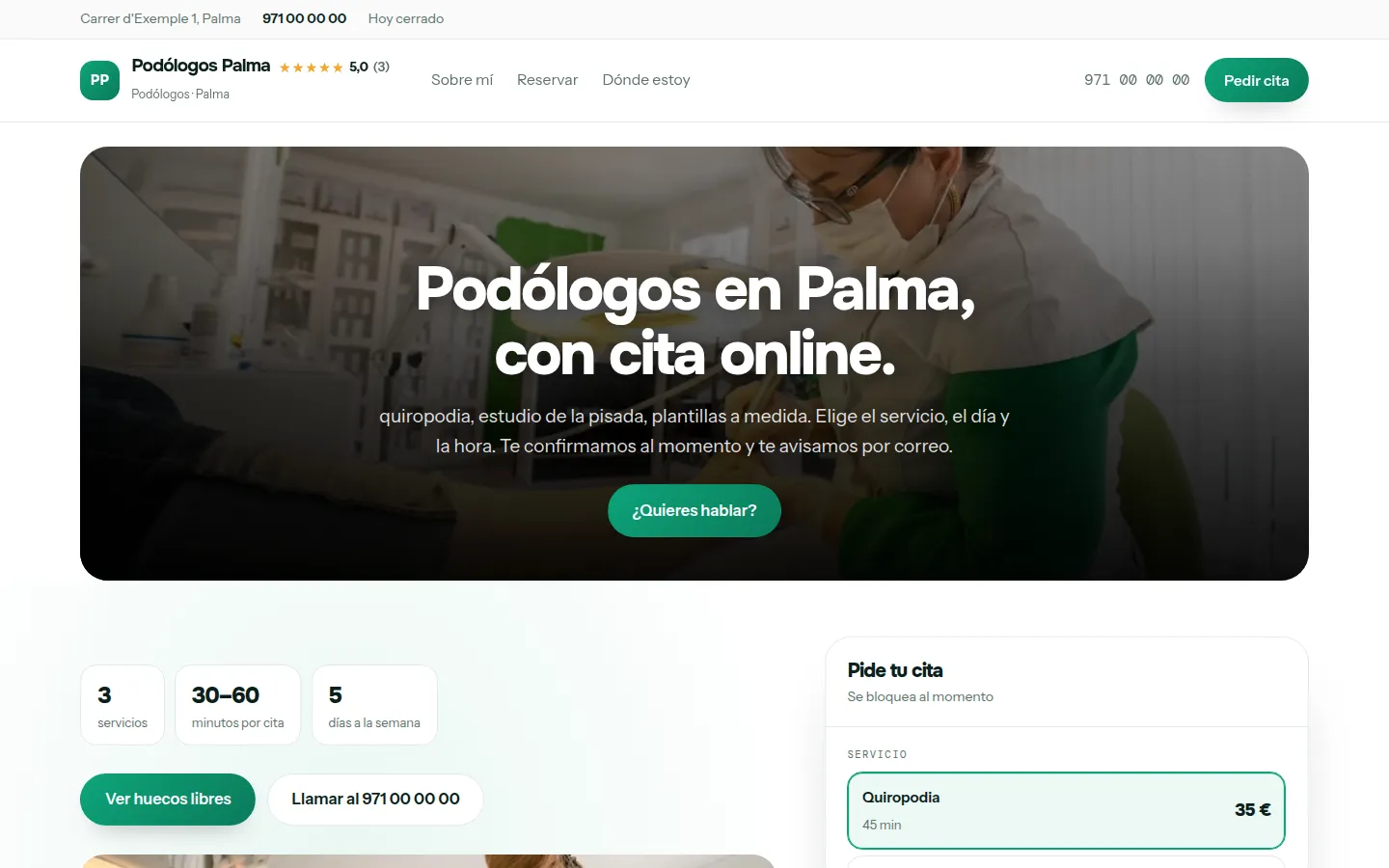
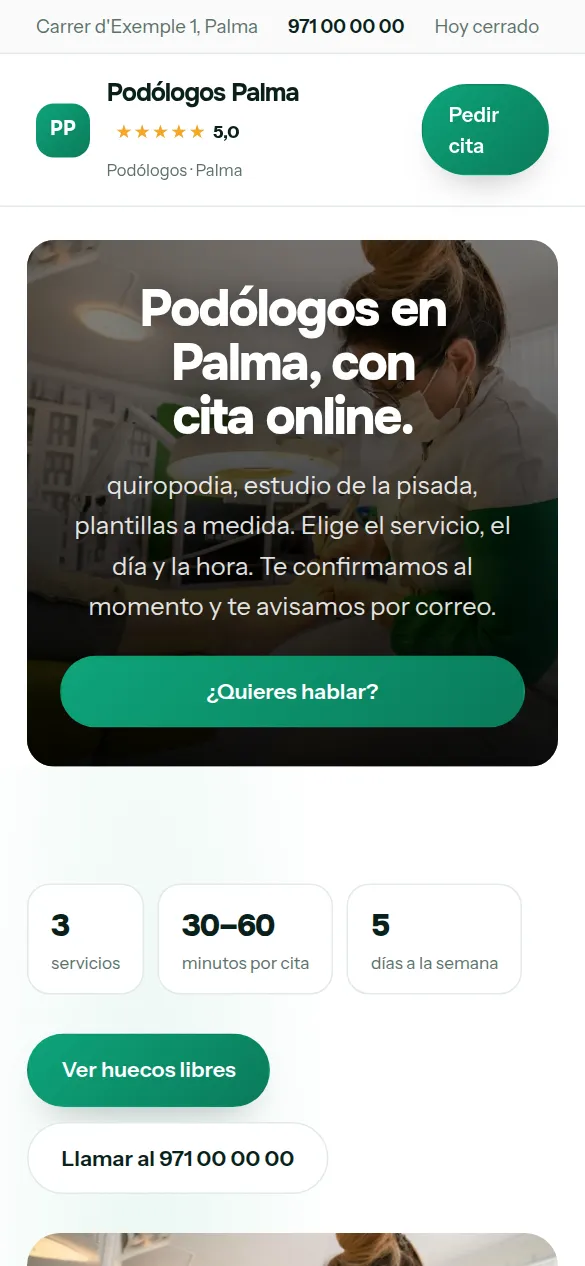
These are not drawings: it is the sample website for podiatrists, live right now, and you can switch design with one click without losing anything you have written.
Some look for it as an online booking calendar for podiatrists, some type “create a website with online bookings” and some search for “appointment software”: here it is the same thing.
It works just the same if your business is called podiatry clinic, podiatry centre or podiatry: it is the same software and the same website.
There are no reviews from podiatrists on Agendra yet: have a look at other customers’ websites.
You pick podiatrists from the list, your website’s name and your phone number, and the website is created with what a business like yours offers (chiropody, gait analysis and custom insoles), which you replace with your own from the dashboard.
Thirty-six designs and your colour, with your podiatry website alongside while you choose. When you finish, it is already live.
Hardly anyone searches just for “podiatrist”: they search for the ingrown toenail that hurts, the insoles their orthopaedic consultant has prescribed or their child’s verruca. Each of those treatments deserves its own line.
The maintenance appointment: hard skin, corns, nails. It’s the one repeated most and the one that fills the diary between long treatments.
With or without surgery. It hurts, people search for it urgently and whoever searches books the same day: it helps if they can book without calling.
What it includes, how long it takes and whether insoles follow. It’s the highest-value service and the one most websites explain worst.
The whole process: assessment, manufacture, fitting and review. With the price, which is the first question.
Check-ups and follow-up. It’s a search with strong intent, made mostly by sons and daughters looking on behalf of their parents.
Treatment and roughly how many sessions it takes. Another urgent search, and a very common one in summer.
Two different audiences with different questions. If you see both, make it visible.
This is the dashboard of your podiatry website, with a full calendar.

Chiropody takes thirty minutes; a biomechanical assessment, a good hour. Squeezing everything into the same half-hour slot is the quickest way to run late all day.
Chiropody, ingrown toenail, gait analysis, insole review. Each one works out its own slots.
Chiropody is repeated every two months. Letting them book the next one from their phone saves the call.
Add the buffer you need between patients for your instruments.
Explain the follow-up and how often it happens: it’s a patient who needs consistency and is looking for someone they can trust.
Gait analysis and insoles for runners, a search with strong buying intent.
If you do home visits, set them up as a service with their travel charge.
Management software for a podiatry clinic has to understand that chiropody is routine and gait analysis is a process: visit, assessment, manufacture and review.
45-minute chiropody, a one-hour biomechanical assessment, a 20-minute insole review. Each one works out its own slots.
The patient picks the day and time without calling. In a clinic with two treatment rooms that’s dozens fewer calls a week.
Chiropody and insoles have very different prices and people ask before they come. Showing them filters out the calls that were never going anywhere.
People looking for a podiatrist are usually in a hurry —a painful corn, an ingrown toenail— or have a specific question, like whether they need a gait analysis. A podiatry clinic’s website has to answer both.
Chiropody, ingrown toenail, biomechanical assessment and insoles, each with its length and what it costs.
Thirty-six looks, your colour, photos of your treatment room and your registration number, so the website looks like your clinic and not like a template.
Address, map and a page for each neighbourhood or town your patients come from.
In a podiatry clinic lots of people book the same thing every few weeks. If those appointments book themselves, the phone is left for what really needs a conversation: the ingrown toenail that hurts today.
Someone searching for “podiatrist ingrown toenail price” wants to know what it costs and whether there’s a slot soon. A guide price, where you are and the booking one tap away.
45-minute chiropody, a one-hour gait analysis, a half-hour insole review: each with its own slot. Often it’s a son or daughter who books from their phone, and the confirmation goes to whoever booked.
A reminder the day before with a button to confirm or cancel, and any slot that frees up is offered again. If you keep some time each day for emergencies, you leave it out of the website’s hours and give it out yourself by phone.
Nobody types “website” when they need podiatrists: they type the problem, the price or the town. These are the searches your website has to answer.
Your patients choose chiropody or gait analysis, a day and a time, and the slot is blocked in your calendar automatically.
Your website live at podologos.agendra.digital, with your services, your opening hours and your bookings, with no card, for 6 months or until your first customer.
Your podiatry website with your own domain, on Google, with Agendra AI and marketing every week. Everything included and no commitment.
If you are torn between this, a custom-built podiatry website or sticking to social media: what each option costs and what it gives you.
Yes, they’re two separate services with their own length, price and description. The calendar offers thirty-minute slots for one and one-hour slots for the other.
Yes. In the opening hours settings you set the gap between appointments, for example ten minutes, and the calendar respects it automatically.
Yes: each treatment with its own length and price, your opening hours, your closures and a gap between patients if you need one. Appointments people ask for by phone or at reception go into the same diary, which you can also see on your phone.
Yes. Whoever has their phone to hand books, and the confirmation and reminder go to that person, who is usually the one making sure the patient gets to the appointment.
Yes. You create the home visit service with its price, and say on your website which area you cover. Booking works the same way.
With the shop template you can publish products with stock and receive orders, as well as appointments.
You can upload your own photos from the dashboard. Be careful with clinical images: ask the patient’s consent before publishing anything recognisable.
On a directory you appear in a list next to other podiatrists in your area, with the platform’s design and terms. With Agendra you have your own website, with your own domain if you connect it, your diary and your patients, for a fixed monthly price and without paying per appointment. It isn’t one or the other: you can keep your directory profile and link from there to your website, where patients book directly with you. We go through it calmly in Doctoralia or Agendra.
Yes. There’s no automatic connection with insurers, but you can say on your website which ones you work with —Sanitas, Adeslas, DKV, Asisa…— and add the question “Are you coming through your insurance? Which one?” to the booking form so you know before the appointment.
Yes, in the header, in “about me” or in the footer. In podiatry it’s one of the first things patients look at: it separates a podiatry clinic from a foot beauty salon.
Chiropody, gait analysis, ingrown toenails and insoles: each treatment with its real length and price, and a calendar that doesn’t get it wrong.
Free until your first customer or 6 months · No card · No commitment · Live in minutes