


Stages and classes
Infant (Infantil), Primary, Secondary (ESO) and Sixth form (Bachillerato), with how many classes per year group and whether there are places.
Open days, visits and admissions: the weeks when families compare three or four schools on their phones. A website that answers them before they call and collects every visit request with its details.
Free until your first customer or 6 months · No card · No commitment · Live in minutes
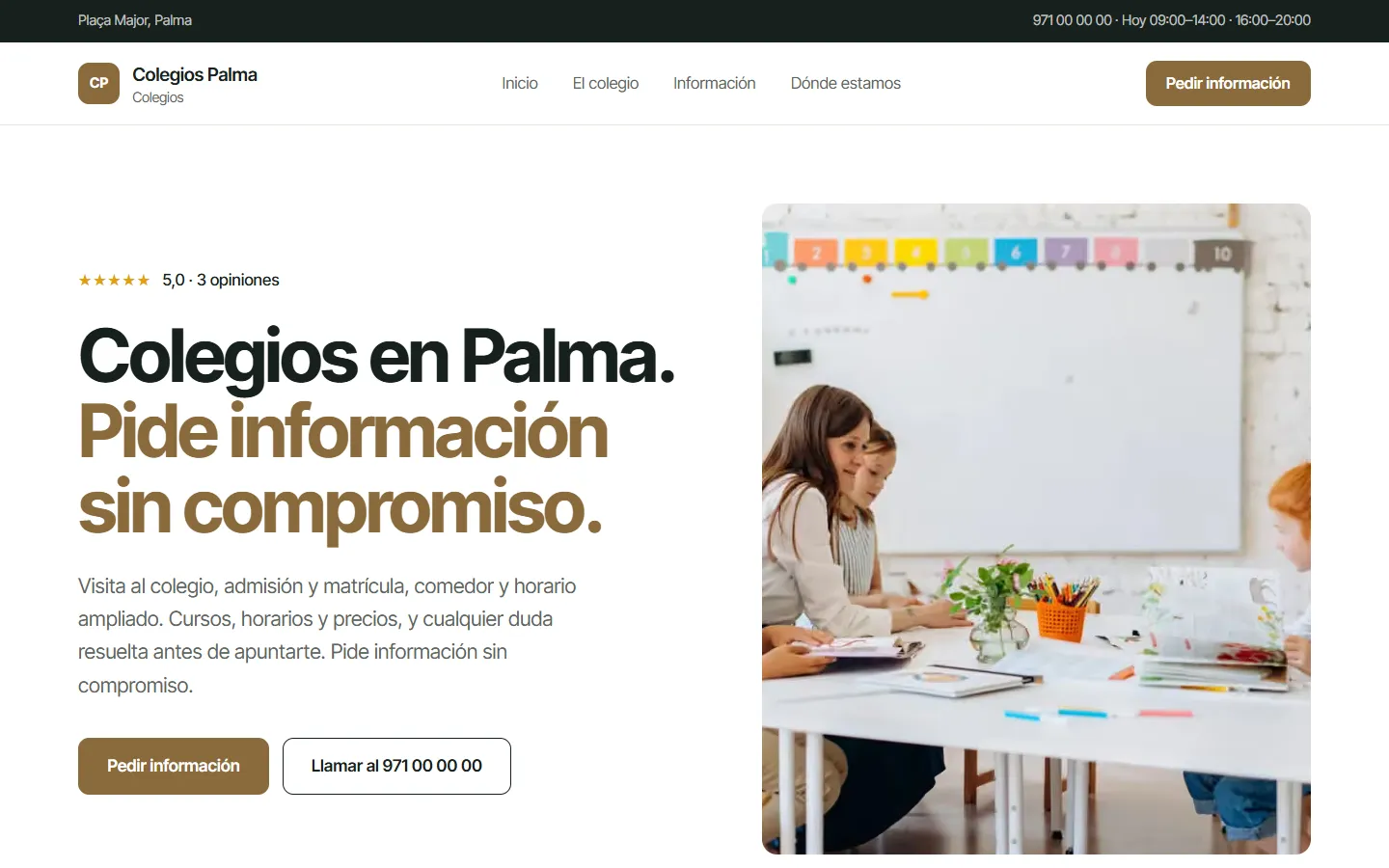
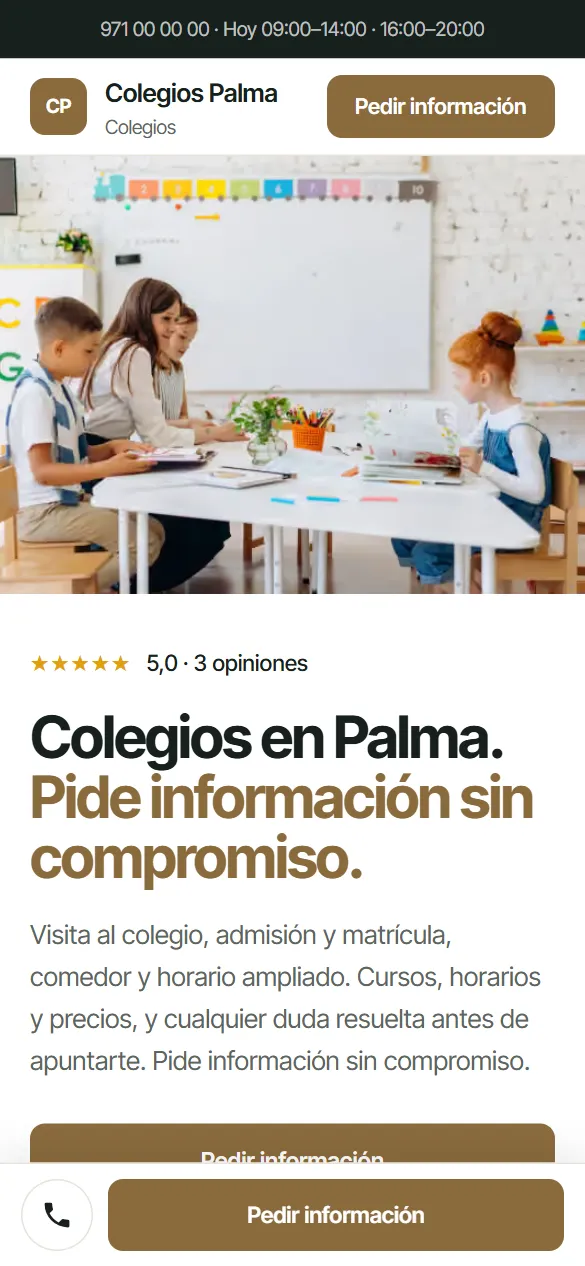
You pick schools from the list, your website’s name and your phone number, and the website is created with what a business like yours offers (school visit, admission and enrolment and school meals and extended hours), which you replace with your own from the dashboard.
Thirty-six designs and your colour, with your school website alongside while you choose. When you finish, it is already live.
There are no reviews from schools on Agendra yet: have a look at other customers’ websites.
Families compare schools for a few weeks a year, and almost always on their phones. What they don’t find on the website they ask about by phone or, more often, they don’t ask and rule the school out.
Infant (Infantil), Primary, Secondary (ESO) and Sixth form (Bachillerato), with how many classes per year group and whether there are places.
What you do differently, told through examples from a school day and not through statements.
Drop-off and pick-up, breakfast club, school meals, transport and after-school activities, with what they cost.
Dates, times and how to sign up, on a page that families share with each other.
Deadlines, documents and steps, and for a state-funded private school (concertado), the link to the regional government’s official procedure.
Hours in English or other languages, whether you are bilingual and which certificates students prepare for.
Classrooms, playground, dining hall and sports hall, and who leads each stage. No recognisable pupils unless authorised.
Nobody types “website” when they need schools: they ask Google about prices, urgency and trust. Answer that, and the website does the selling.
Whoever needs school visit or admission and enrolment calls you, messages you on WhatsApp or asks through a form that asks what is needed and where.
The school visit starts at home, with the website open. Families arrive at the open day with some schools already ruled out, and what rules them out is not finding the basics.
Infant, Primary, Secondary or Sixth form, and how many classes per year group. It’s the first thing people look at, and many schools don’t say it anywhere.
What you do differently and how it shows on a normal school day. Told with examples, not with “holistic, values-based education”.
What time school starts and finishes, whether there is a breakfast club, school meals and after-school activities. For many families this matters more than the approach.
At a private school, the fees; at a state-funded private school, which services are optional and what they cost. Saying it clearly saves visits that were never going to end in enrolment.
During the admissions months the school office phone never stops, and it’s almost always about the same thing. Every call asking when the open day is is a call the website could have answered.
Each open day with its date, its time and what will be shown, on its own page that families pass around on WhatsApp.
The form asks what you need: which year group, how many children and which days suit them. Every request reaches your email and your phone, and the office calls back with everything in front of them.
Deadlines, documents and how the process works in your region. At a state-funded private school, the official application goes through its own channel: the website explains it and links to it.
Photos of the open day and of the facilities. The decision is made at home days later, and those who couldn’t come decide too.
A family is going to leave their child there for many years. Before enrolling they want to see the school, know who runs it and understand how things work.
Classrooms, playground, dining hall, laboratory, sports hall. Real photos, with no recognisable pupils unless their families have authorised it in writing.
Who runs the school, who coordinates each stage and how to contact the class tutor. A name and a face are more reassuring than an organisation chart.
Whether you are bilingual or prepare students for official certificates, in which subjects and for how many hours. And if you take families from abroad, the website can also be in English.
Trips, competitions, the end-of-year play. The blog shows a lively school and gives Google something new to read.
A school doesn’t need yet another program for its website: it already has its school management system. What it lacks is a place where families find what they ask about by phone, and from which they can request a visit without waiting for the office to answer.
Stages, timetable, school meals, breakfast club and what each service costs, each on its own page and written to be read on a phone.
Year group, number of children and days that suit them, on the form. They reach the school office’s email and phone, and they stay saved.
A new open day, a year group with no places, the June timetable. You change it from the dashboard, without waiting for whoever built your website.
During admissions, the office answers the same questions over and over: when the open day is, whether there are places in a given year, what time school meals are. Every answer already on the website is one call fewer and a family that arrives at the visit with the basics sorted.
Anyone searching “state-funded private school near me” or “school open day” is comparing. Stages, timetable, services and visit dates, in writing, and the information request one tap away.
Year group, number of children and days that suit them, on the same form. It reaches the office’s email and phone, and you call once, with everything in front of you.
If a year group has no places left or a waiting list opens, you change it on the website in a minute. It saves visits from families who have no place and calls that end in a no.
These are not drawings: it is the sample website for schools, live right now, and you can switch design with one click without losing anything you have written.
Some look for it as management software for schools, others as a services website and others as online quotes: here it is the same thing.
It works just the same if your business is called school, private school, state-funded private school (concertado), primary school or bilingual school: it is the same software and the same website.
Your website live at colegios.agendra.digital, with your services, your opening hours and your contact form, with no card, for 6 months or until your first customer.
Your school website with your own domain, on Google, with Agendra AI and marketing every week. Everything included and no commitment.
If you are torn between this, a custom-built school website or sticking to social media: what each option costs and what it gives you.
Yes. The contact form has the questions you choose — year group, number of children, days that suit them — and every request reaches the school office’s email and arrives as a notification on your phone, and is saved in the dashboard. If you’d rather families chose a slot with a date and time themselves, you switch on appointments in My website › Forms.
What happens during the school year and what new families ask: a trip, a class project, what the first day in Infant school is like, what is served at lunch. A school that posts every now and then looks alive, and those posts answer questions families search for months before admissions.
To collect interest, yes: the form asks for the details you decide and every request is saved in the dashboard. At a state-funded private school the official application goes through the regional government’s procedure, and enrolment at a private school goes through your office: the website explains it and takes each family to the right place.
Yes: one for Infant, another for Primary, another for Secondary, each with its own address, its own timetable and what makes it different. Families search by stage, and a single page for everything doesn’t answer any of them well.
Only with the express written authorisation of their families, and even then it’s best that faces can’t be recognised. Photos of the school, of hands at work or of a group from behind tell the same story with no risk at all, and you upload them yourselves, so you decide what is shown.
With its own page or a blog post for each open day: date, time, what is visited and how to sign up. When it’s over, don’t delete it: with the photos it stays as that year’s open day, which is what people who arrive late will find.
Yes, on its own page with its own address, linked from the menu. It’s what the most involved families read carefully, and what best sets one school apart from another with similar facilities. Better with examples of how it is applied than with statements.
Yes: it can be in Spanish and in English, each version with its own address (/es and /en). It’s what a bilingual school or one with families from other countries needs, as they look for a school in their own language.
Yes. From the dashboard you add real reviews from families, with their permission, and they appear with their stars on every page of your website, with the average rating next to your name. They can’t be made up and they aren’t pulled in from Google automatically: what is published is what people have really told you.
Open days, visits and admissions: the weeks when families compare three or four schools on their phones. A website that answers them before they call and collects every visit request with its details.
Free until your first customer or 6 months · No card · No commitment · Live in minutes