


Children’s occupational therapy
Sensory integration, motor skills, independence at school and at home. A family referred by the paediatrician or the school searches for it.
Children’s therapy, neurorehabilitation or home adaptations: explain your work to families who hardly ever know what occupational therapy is, and let them book.
Free until your first customer or 6 months · No card · No commitment · Live in minutes
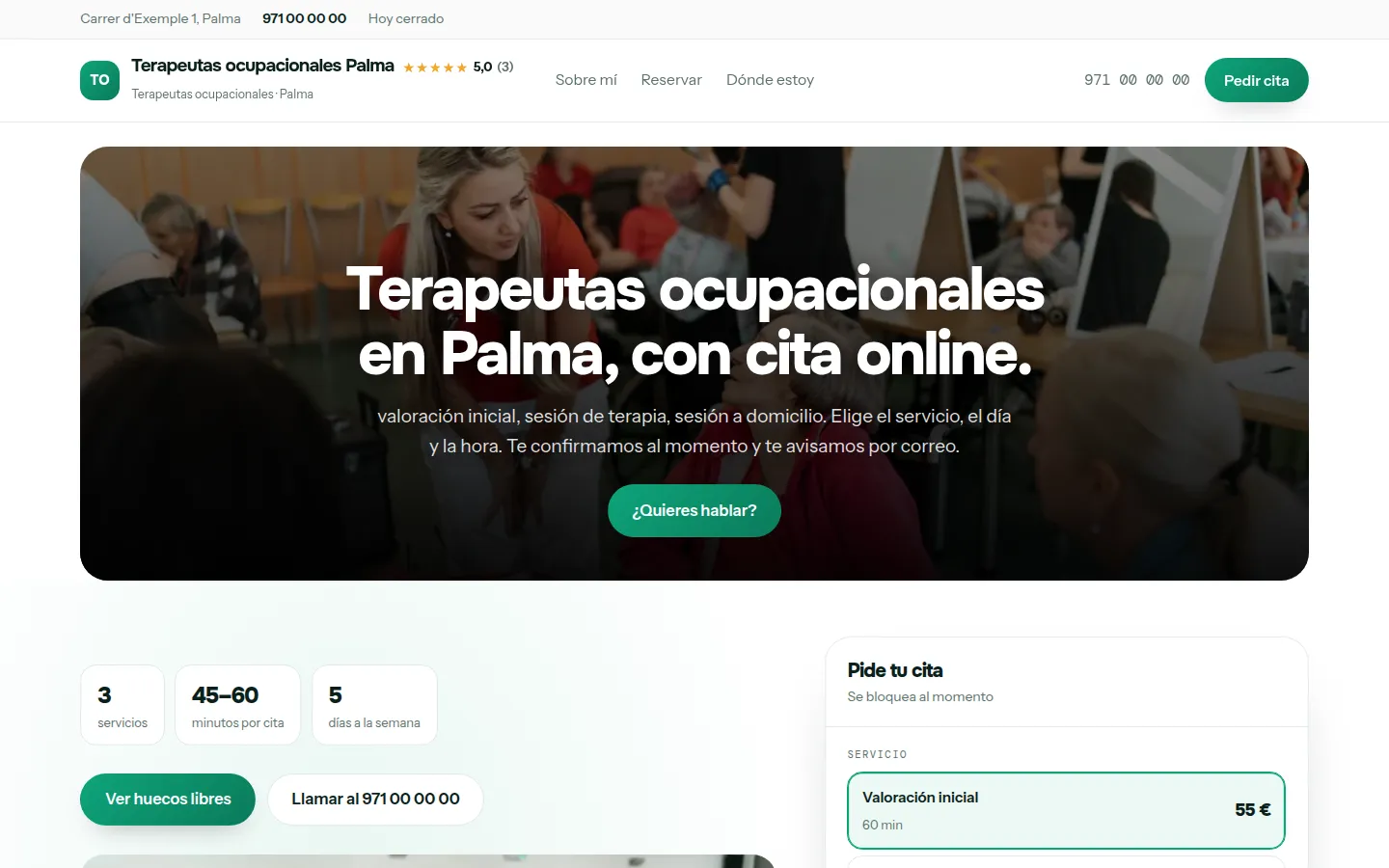
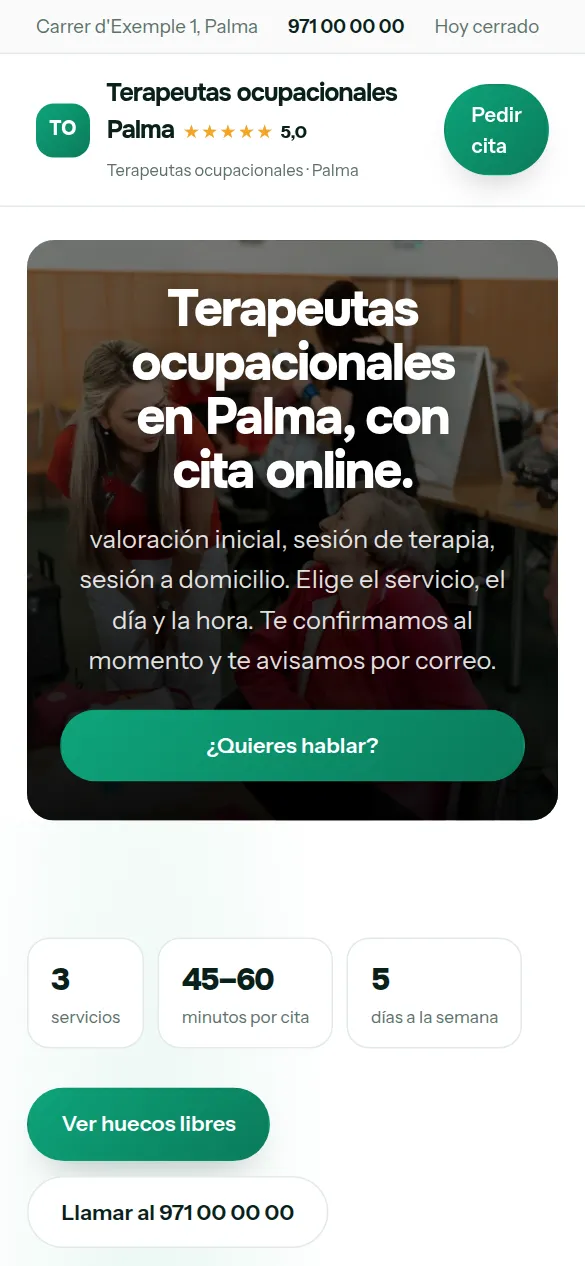
These are not drawings: it is the sample website for occupational therapists, live right now, and you can switch design with one click without losing anything you have written.
Some look for it as an online booking calendar for occupational therapists, some type “create a website with online bookings” and some search for “appointment software”: here it is the same thing.
There are no reviews from occupational therapists on Agendra yet: have a look at other customers’ websites.
You pick occupational therapists from the list, your website’s name and your phone number, and the website is created with what a business like yours offers (initial assessment, therapy session and home visit session), which you replace with your own from the dashboard.
Thirty-six designs and your colour, with your occupational therapy website alongside while you choose. When you finish, it is already live.
Occupational therapy is one of the worst-explained professions there is: lots of people who need it don’t even know it exists. The website has to say what it achieves, not what it’s called.
Sensory integration, motor skills, independence at school and at home. A family referred by the paediatrician or the school searches for it.
Stroke, acquired brain injury, Parkinson’s, multiple sclerosis. Getting back the arm, the hand and everyday life.
Getting dressed, cooking, going out. A son or daughter searches for it, usually after there’s already been a fall.
Accessibility report, bathroom, grab rails, assistive products. A specific service hardly anyone publishes.
If you go to people’s homes, the area and the price. In this profession it’s more the rule than the exception.
For school, for the insurer, for a dependency assessment. It’s a paid service with demand of its own.
This is the dashboard of your occupational therapy website, with a full calendar.

It’s the worst-explained health profession. A website that tells it with concrete examples converts far better than one that lists techniques.
“Getting dressed on his own again” says more than “promoting independence in activities of daily living”.
Children, brain injury, older people, mental health. Each group searches using different words.
Publish it as a service with its length and price: it’s how everyone comes in.
With afternoon hours, which is when children come.
With the travel charge and the area you cover.
The home adaptation report is a service in its own right and can be booked.
Occupational therapy happens where the problem is: at home, at school or in the clinic. Management software that only understands “clinic” doesn’t work here.
Two separate services, with a different length and price, because travel is paid for and the time isn’t the same.
Most cases are recurring sessions. They’re booked once and confirmed by email.
Children’s therapy, neurorehabilitation or home adaptation: each area with its own page and its own vocabulary.
If part of your day goes on answering messages to give out times, the problem isn’t WhatsApp: it’s that families have nowhere to see your free slots. With booking on your website they can see them, choose, and the appointment goes into your diary on its own, with the length of each service —a one-hour initial assessment and a 45-minute therapy session.
Your website answers what families type before choosing —“what is occupational therapy and what is it for”, for example— and booking is one tap away. The day after each appointment, an email asks for their review, which is what matters most to the next family.
Appointments families ask for by phone go into the same diary and the ones from the website go in on their own: a single list, on your phone, and no slot given out twice.
A reminder the day before with a button to confirm or cancel, minimum notice for booking and, for the longest appointments —the initial assessment, for example— a deposit you request by Bizum (Spain’s instant bank-to-bank mobile payment) or bank transfer from the booking itself.
Nobody types “website” when they need occupational therapists: they ask Google about prices, urgency and trust. Answer that, and the website does the selling.
Families choose initial assessment or therapy session, a day and a time, and the slot is blocked in your calendar automatically.
Your website live at terapeutas-ocupacionales.agendra.digital, with your services, your opening hours and your bookings, with no card, for 6 months or until your first customer.
Your occupational therapy website with your own domain, on Google, with Agendra AI and marketing every week. Everything included and no commitment.
If you are torn between this, a custom-built occupational therapy website or sticking to social media: what each option costs and what it gives you.
Yes, they’re two services with different prices and lengths. In each one’s description you explain which area you cover and what’s included.
Yes. You set only that shift and the calendar only offers those hours, not a single day or hour more.
Yes. Families choose the service, day and time on your website, and the booking goes into your diary with its length —a one-hour initial assessment and a 45-minute therapy session. You see it in the dashboard and on your phone, you note down there the appointments you get by phone and, on every plan, you also have it in Google Calendar. It doesn’t do invoicing or accounts: it’s the diary and the website.
The website works as your professional shop window and the form collects enquiries. Partnerships with centres are agreed with you, not through the calendar.
Yes, as long as they can’t be identified. Describe the situation and the result without names, exact ages or recognisable photos.
Yes, with the blog or your own pages. Materials for use at home are among the most searched-for things in this field.
On a directory you appear in a list next to other occupational therapists in your area, with the platform’s design and terms. With Agendra you have your own website, with your own domain if you connect it, your diary and your patients, for a fixed monthly price and without paying per appointment. It isn’t one or the other: you can keep your directory profile and link from there to your website, where patients book directly with you. We go through it calmly in Doctoralia or Agendra.
Children’s therapy, neurorehabilitation or home adaptations: explain your work to families who hardly ever know what occupational therapy is, and let them book.
Free until your first customer or 6 months · No card · No commitment · Live in minutes