


Roof leak repair
The stain on the ceiling, what you found up there and the fix. It’s what people search for most and what raises the most questions.
Leaks, re-roofing, waterproofing, gutters and rope access work. A job the customer never sees — it’s on top of their house — and that they book when water is already coming in or when the owners’ association approves it at a meeting.
Free until your first customer or 6 months · No card · No commitment · Live in minutes
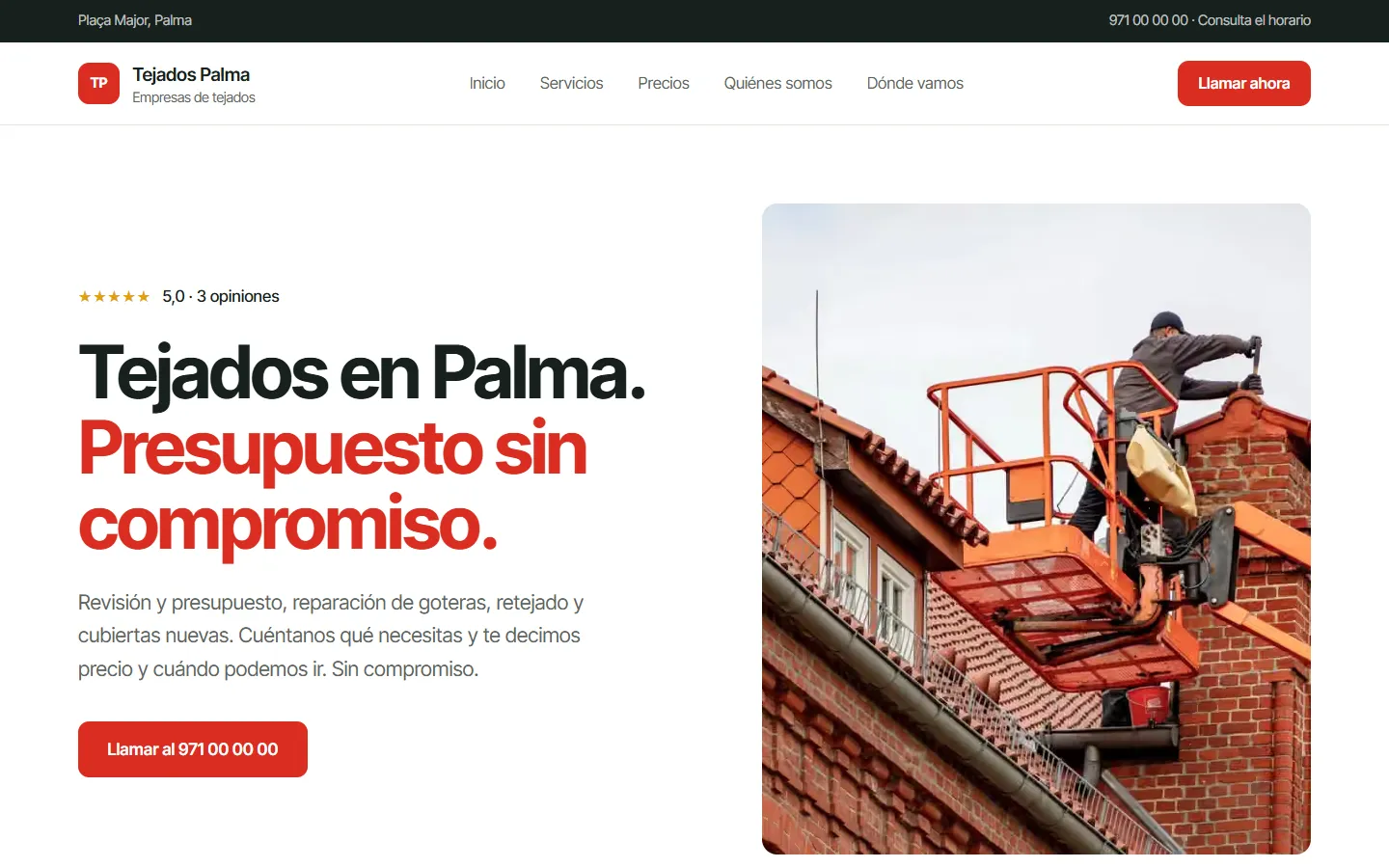

You pick roofers from the list, your website’s name and your phone number, and the website is created with what a business like yours offers (inspection and quote, roof leak repair, re-roofing and new roofs, waterproofing, gutters and downpipes and rope access work), which you replace with your own from the dashboard.
Thirty-six designs and your colour, with your roofing website alongside while you choose. When you finish, it is already live.
With their name and their website, so you can check. Translated from Spanish.
“I used to miss a lot of calls because I was on a job. Now customers book from the website at any time and I just check my phone when I can. Very easy to set up.”
 Esteban JiménezCerrajería Jiménez e Hijos
“I needed a professional website so people would take us seriously. In less than an afternoon it was live with our services and a contact form. Highly recommended.”
Nobody sees their own roof, so what convinces people is the photos: how it was, what you found up there and how it ended up. And the exact name of what’s wrong, which is what they type into the search engine.
The stain on the ceiling, what you found up there and the fix. It’s what people search for most and what raises the most questions.
Old tiles off, a check of the structure, insulation if it has any and new tiles. With photos of each stage: nobody ever sees what’s underneath.
Each material with its jobs. Where slate is used, or on industrial units, people search by the name of the material.
Terraces, flat rooftops and flat roofs with bitumen membrane, rubber or polyurea, and why that material for that case.
Cleaning, repairs and new gutters. A small job that brings in the customer who later hires you for the roof.
Façades, cornices and cleaning with ropes, no scaffolding. With photos of you hanging from the façade: it’s what catches the eye most.
Lifeline, harness, scaffolding or platform, and your public liability insurance. The owners’ association asks before letting you up.
Nobody types “website” when they need roofers: they type the problem, the price or the town. These are the searches your website has to answer.
Whoever needs roof leak repair or re-roofing and new roofs calls you, messages you on WhatsApp or asks through a form that asks what is needed and where.
The customer doesn’t go up on their roof. They know there’s a stain on the ceiling or that water runs down the façade, and they have to trust what they’re told by whoever does go up. The website is where they decide who to trust before calling.
The broken tile, the loose gutter, the lifted membrane, and how it ended up. It’s the only way for someone to see what you see from up there.
Re-roofing, roof leak repair, terrace waterproofing, gutters, rope access work. Someone with a leak doesn’t search for “roofing”: they search for their problem.
Clay or concrete tiles, slate, sandwich panels, metal sheeting, bitumen membrane, rubber or polyurea. Saying so filters out people looking for something else and reassures those looking for what you do.
The towns where you work, each with its own page. People look for a roofer nearby: “roof repair in” and the name of the town.
Anyone calling with water in the ceiling wants to know three things: whether you’ll come soon, whether you’ll find the source first time and whether the repair will last. Whatever the website answers before the call is time you don’t spend on the phone.
The stain on the ceiling is almost never right under the broken tile: water runs inside before it shows. Explaining how you find where it gets in is what sets you apart from someone who changes three tiles and leaves.
When fixing the area is enough and when it’s worth re-roofing or waterproofing the whole thing. Saying it honestly is what makes people call you again.
What can’t wait is covered as best it can be — a tarpaulin, a temporary seal — and the real repair is done in the dry. In writing, it saves the argument about why you didn’t go up yesterday.
Lifeline, harness, scaffolding or platform depending on the job. An owners’ association or a company cares about knowing you go up with the equipment the law requires, and it protects you.
The owner of a house with leaks, the manager of an owners’ association whose building roof needs waterproofing and the owner of an industrial unit with old fibre cement don’t look for the same thing or decide the same way. If you work for all three, let each find what’s theirs.
Re-roofing, leaks, gutters and roof cleaning. They decide quickly, especially if water is already coming in, and compare two or three quotes.
Communal roofs and terraces, downpipes, façades. The quote is approved at a meeting: it has to be something that can be shown, with what it includes and what it doesn’t.
Sandwich panels, metal sheeting, skylights and removing fibre cement roofs containing asbestos, which can only be done by a company listed in the RERA (Spain’s official register of companies that work with asbestos) with its work plan approved. If you are, say so.
Façades, cornices, high gutters or cleaning without putting up scaffolding. It saves the customer time and money, and hardly anyone explains it on their website.
People look for a roofer with the water already inside the house or with the owners’ meeting breathing down their neck. What the website has to do is get you found for what’s happening to them and make sure the request reaches you with what you need to know whether to go up.
Leaks, re-roofing, waterproofing, gutters. Someone searching “fix roof leak” doesn’t need to scroll through photos of an industrial unit.
The form can include a photo field, and the stain on the ceiling or the broken tile arrives with the request. You know what it is before you load the ladder.
The towns where you work, with jobs done there. A roof gets fixed by someone local, and that’s how people search.
A roofing company gets calls both from people with water pouring into the living room and from people who want to know, just in case, how much it would cost to replace the roof some day. Answering isn’t what’s expensive: it’s going up, inspecting and preparing a quote for a job that was never going to happen.
Anyone searching “roof leak repair” or “waterproofing a communal terrace” has something to fix and is looking for who to do it. Jobs similar to theirs, in their area, and the request one tap away.
What’s happening, where, whether it’s a house, an owners’ association or an industrial unit, and a photo if they have one. Before calling you already know whether it’s a loose tile or a whole roof.
How you work at height, what guarantee you give and with which materials, written on the website. Anyone who has read it lets you go up without asking for explanations.
These are not drawings: it is the sample website for roofers, live right now, and you can switch design with one click without losing anything you have written.
Some look for it as management software for roofers, others as a services website and others as online quotes: here it is the same thing.
It works just the same if your business is called roofer, roofing company, roofing, re-roofing, roof repair, roof leaks, waterproofing, gutters, rope access work, roof repairs, guttering, roofing contractor, roofing specialist or waterproofing contractor: it is the same software and the same website.
Your website live at tejados.agendra.digital, with your services, your opening hours and your contact form, with no card, for 6 months or until your first customer.
Your roofing website with your own domain, on Google, with Agendra AI and marketing every week. Everything included and no commitment.
If you are torn between this, a custom-built roofing website or sticking to social media: what each option costs and what it gives you.
A recommendation comes with a name and a phone number: “call this one, he fixed my roof”. The next thing almost everyone does is look you up. If they find roofs you’ve fixed, the area where you work and how to ask you for a quote, they call; if they find nothing, they keep looking.
Yes, and it’s a good idea: it’s exactly what people search for most, a leak or some slipped tiles. The photo of the broken tile and the one of the finished repair are more convincing than a big job that looks nothing like what the person looking has at home.
Yes: each request arrives with whatever your form asks — what’s happening, where, a photo if you ask for one — to your email and your phone, and you have them all in the dashboard. It doesn’t measure roofs or prepare quotes: you still do that, after going up.
Yes: each service can be marked “Ask”, and that’s how it shows on the website, not as free. If one day you want to give a guide price for something that’s always the same — the inspection, cleaning a house’s gutters — you change it from the dashboard.
You can, although on a roof almost everything depends on seeing it: the area, the pitch, the access and what’s under the tiles. The sensible thing is to price what’s always the same — an inspection, cleaning a house’s gutters — and leave the rest as “Ask”. In the dashboard, each service is set up however you decide.
Yes: a photo field can be added to the form, always optional, and the photo arrives with the request. With the stain on the ceiling or the broken tile in front of you, you know before going what material to take, or whether it’s really a gutter problem.
Only if your company is listed in the Register of Companies at Risk from Asbestos (RERA) and each removal has its work plan approved by the labour authority. If so, put it on the website, because it’s the first thing someone with an industrial unit or a garage with fibre cement checks; if not, better not to offer it.
Yes: “roof leak repair”, “terrace waterproofing” or “gutter cleaning” are searched for separately, and almost always with the name of the town after them. Each page with its own address and with real jobs of that type or in that area: a page that only changes the name of the town adds nothing, and Google notices.
You can stay on it. The difference is that on the quotes site the same request usually goes to several roofers at once and the customer compares before getting to know you; on your website, whoever writes has already seen your roofs and is writing to you, and you pay the same each month, with no cost per lead.
No. Agendra doesn’t do quotes or invoices, or send anything to the tax office (Hacienda): you keep doing them with your software or with your gestoría (an administrative and tax agency). What it does do is make every request that comes through the website alert you by email and stay saved in the dashboard, with the name, the phone number and what they need.
Leaks, re-roofing, waterproofing, gutters and rope access work. A job the customer never sees — it’s on top of their house — and that they book when water is already coming in or when the owners’ association approves it at a meeting.
Free until your first customer or 6 months · No card · No commitment · Live in minutes