


Represented artists
Each with their career, their way of working and their available work. Their name is what people search for most.
Your artists, the current exhibition and the available work with its size and price. So anyone who discovers you at an opening or an art fair can come back for another look, and buy, without waiting for the next show.
Free until your first customer or 6 months · No card · No commitment · Live in minutes
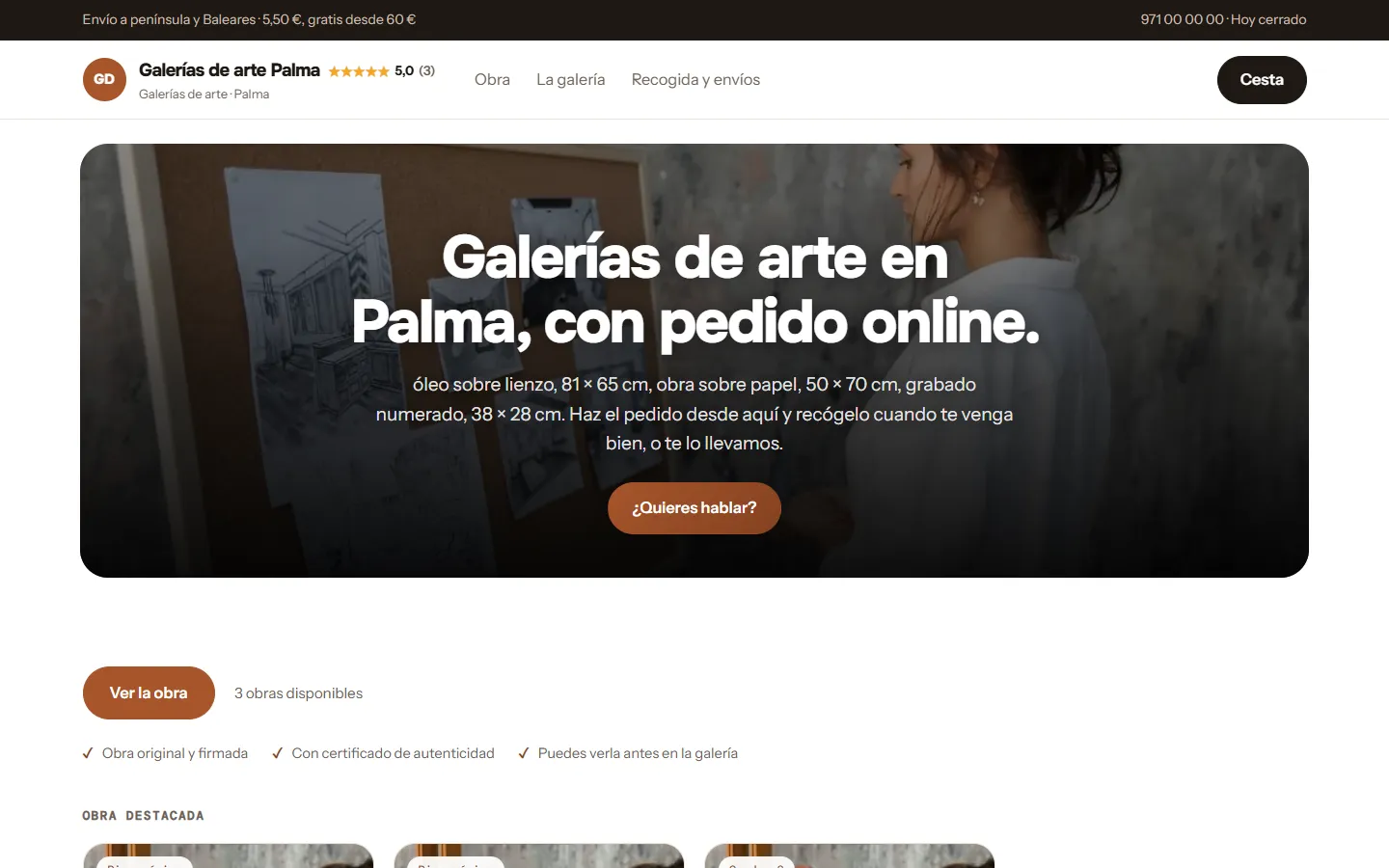
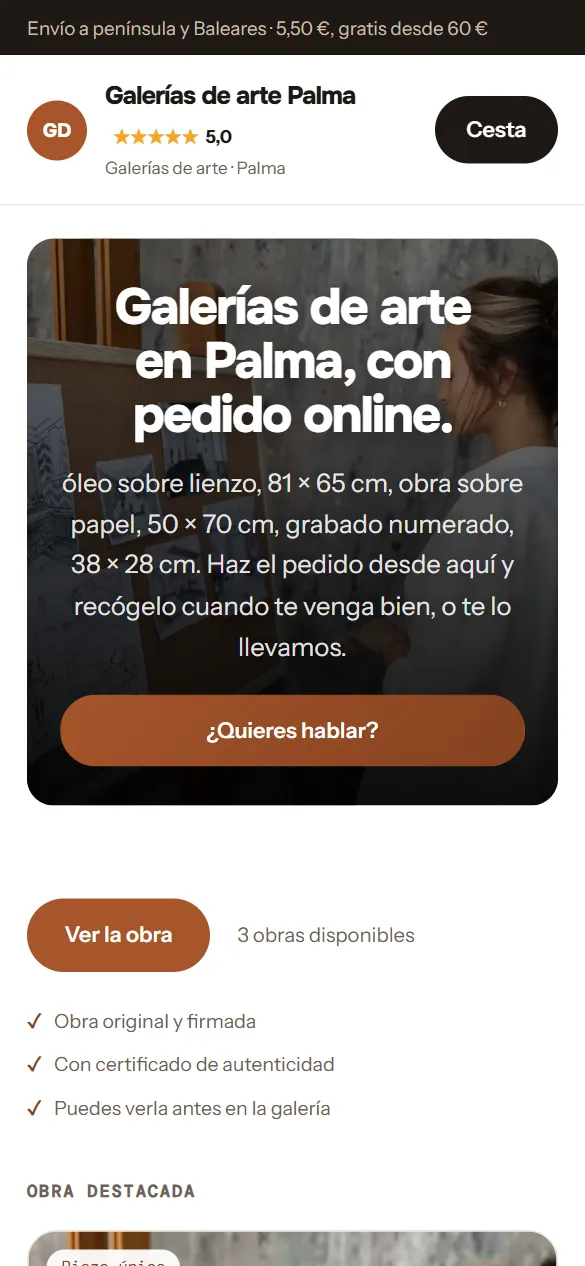
A gallery sells judgement: which artists it has chosen and why. The website has to show that selection and, at the same time, make it easy to ask about a work or buy it.
Each with their career, their way of working and their available work. Their name is what people search for most.
Title, technique, size, year and price. And it disappears once sold, which is what builds trust.
Dates, opening hours, address and photos of the space. What people look for after seeing the poster.
The gallery’s archive, with photos. Collectors and artists look at it before writing to you.
Etchings, screen prints or photography in numbered editions. A lower price and many people’s first purchase.
Certificate, packing and transport insurance. The doubts that hold back people buying from far away.
Where you’ll be, and with which artists. It brings back people who met you at a stand.
With their name and their website, so you can check. Translated from Spanish.
“We wanted a clean website to show our cars and make it easy for people to contact us. Agendra solved it for us with no hassle and no big costs.”
 Miguel Ángel GómezMAG Import Cars
These are not drawings: it is the sample website for art galleries, live right now, and you can switch design with one click without losing anything you have written.
Call it an online catalogue, a shop or an ordering system: for art galleries it is the same thing.
It works just the same if your business is called art gallery, gallery, contemporary art, artwork sales or painting gallery: it is the same software and the same website.
You pick art galleries from the list, your website’s name and your phone number, and the website is created with what a business like yours offers (oil on canvas, 81 × 65 cm, work on paper, 50 × 70 cm and numbered print, 38 × 28 cm), which you replace with your own from the dashboard.
Thirty-six designs and your colour, with your art gallery website alongside while you choose. When you finish, it is already live.
Oil on canvas, 81 × 65 cm and work on paper, 50 × 70 cm, each with its photo, price and stock, and the order placed from the website, with no commission per sale.
Anyone visiting a gallery’s website wants to know who you represent and what each of them has done. A single work with no name or career behind it gets looked at; a work by an artist you already know gets bought.
Their career, their way of working and their available work. It’s what people find by searching their name, and what the artist shares themselves.
Title, technique, size, year and price. Size is the first thing someone checks when they have a particular wall in mind.
Each work has a single unit: once it sells, it’s no longer offered. Nobody pays for a piece that’s already hanging in someone else’s home.
Etchings, photography or screen prints in numbered editions. It’s the way in for first-time buyers.
An exhibition is seen for a few weeks and then forgotten. Told on your website, with photos of the space and the work that’s left, it keeps selling after you’ve taken it down.
Dates, artist, opening hours and address. It’s what people look for after seeing the poster or a social media post.
Announced well in advance, on the blog or on a page of their own. The list of who comes is the list of who buys.
Each with its photos and text. It’s the gallery’s CV and what an artist looks at before proposing a show to you.
Where you’ll be and with which artists. People who met you at a stand look you up by name afterwards.
Buying art is daunting, especially the first time. Nearly all the doubts are the same, and answering them on your website is what makes someone write to you instead of just carrying on looking.
Whether the work comes with a certificate signed by the artist or the gallery. It’s any collector’s first question.
How a work is packed, whether it travels insured and how long it takes. People buying from another city need to read this before paying.
That they can drop into the gallery to see it, or ask for a visit outside opening hours. A large work is decided standing in front of it.
If any of your artists take made-to-order commissions, say so. Interior designers and companies look for this for specific projects.
People who discover you at an opening, at a fair or on one of your artists’ profiles look you up again days later. If at that moment they find the work with its details and can order it or ask about it, the sale doesn’t wait for the next exhibition.
Title, technique, size and price, and as soon as it sells it’s no longer offered. No out-of-date lists or works that are no longer there.
A form and WhatsApp on every page for anyone who wants to see it in person or learn more about the artist. In art, most sales start this way.
A fixed monthly fee. On work costing hundreds or thousands of euros, a marketplace’s commission is a lot of money on every piece.
Lots of people see a work at an opening, at a fair or on an artist’s profile, and don’t buy that day. They decide later, at home, and what they do then is look up the gallery. If they don’t find the work with its details, the decision cools off.
Each artist with their page and available work. People searching their name reach you, the gallery that represents them, and not a marketplace that sells everything.
Technique, size, year, price and whether it’s available. Sold work stops being offered automatically, and nobody gets their hopes up over a piece already on someone else’s wall.
A form and WhatsApp on every page, for anyone who wants to see it in person or learn more. High-priced work almost always starts this way.
Nobody types “website” when they need art galleries: they type the problem, the price or the town. These are the searches your website has to answer.
This is the dashboard of your art gallery website, with a full calendar.

Your website live at galerias-de-arte.agendra.digital, with your products, your opening hours and your orders, with no card, for 6 months or until your first customer.
Your art gallery website with your own domain, on Google, with Agendra AI and marketing every week. Everything included and no commitment.
If you are torn between this, a custom-built art gallery website or sticking to social media: what each option costs and what it gives you.
Both. Each work is a product with its details, its price and one unit: whoever wants it orders it from the website and, as soon as it sells, it’s no longer offered. If you’d rather sell a piece in person, don’t put it in the shop: show it on its artist’s page, with its details, and let people ask about it through the form.
Yes, and it’s a good idea: their name is what people search for most and what the artist links to from their own social media. You create them from the dashboard, each with its own address, text and photos. What isn’t a good idea is making almost empty pages: an artist with three lines and no work says little about the gallery.
Yes: each work is a product with its price and units, and the order reaches you instantly, with no commission per sale. What it doesn’t do is value artwork or run the gallery’s inventory: it’s the shop window and the till, not the management software.
In the shop, every work has its price. Any work you’d rather not put on sale you can show on its artist’s page or in the photo gallery, with its details and “price on request” written in the text, and anyone interested writes to you through the form or on WhatsApp. That’s the usual approach with high-priced work.
With a blog post or a page of its own, with the dates, the artist, the opening hours and photos of the work. When it ends, don’t delete it: with the photos of the space it becomes a past exhibition, which is what an artist or a collector looks at to see how you work.
It helps people find them and look at them with all the details. High-priced works are almost never bought with one click, and they don’t need to be: the contact form and the WhatsApp button bring in people who want to see the work, learn more about the artist or talk about payment. The website does the first part, which is getting them to write to you.
Yes, with the photo gallery and in each exhibition. A work seen on a wall, with scale, is easier to understand than one cut out on a white background. Photos are resized automatically when you upload them, so you can upload lots without slowing the website down.
On a marketplace, your artists’ work appears next to thousands of others, with the platform’s commission and rules, and the buyer belongs to the marketplace. On your website there’s only you, with your selection and your way of presenting it, and you pay no commission per sale. You can stay on the marketplace and bring people who already know you to your website.
Yes. From the dashboard you add real reviews from your customers, with their permission, and they appear with their stars on every page of your website, with the average rating next to your name. They can’t be made up and they aren’t pulled in automatically from Google: what gets published is what people have genuinely told you.
Your artists, the current exhibition and the available work with its size and price. So anyone who discovers you at an opening or an art fair can come back for another look, and buy, without waiting for the next show.
Free until your first customer or 6 months · No card · No commitment · Live in minutes