


Available work
Each piece with title, medium, size, year and price. Just one unit for originals.
Painting, illustration or sculpture: your available work with its size and price, prints with their edition and a clear way to ask you for a commission. So that anyone who discovers you at a fair or on Instagram can buy from you, with no middlemen.
Free until your first customer or 6 months · No card · No commitment · Live in minutes
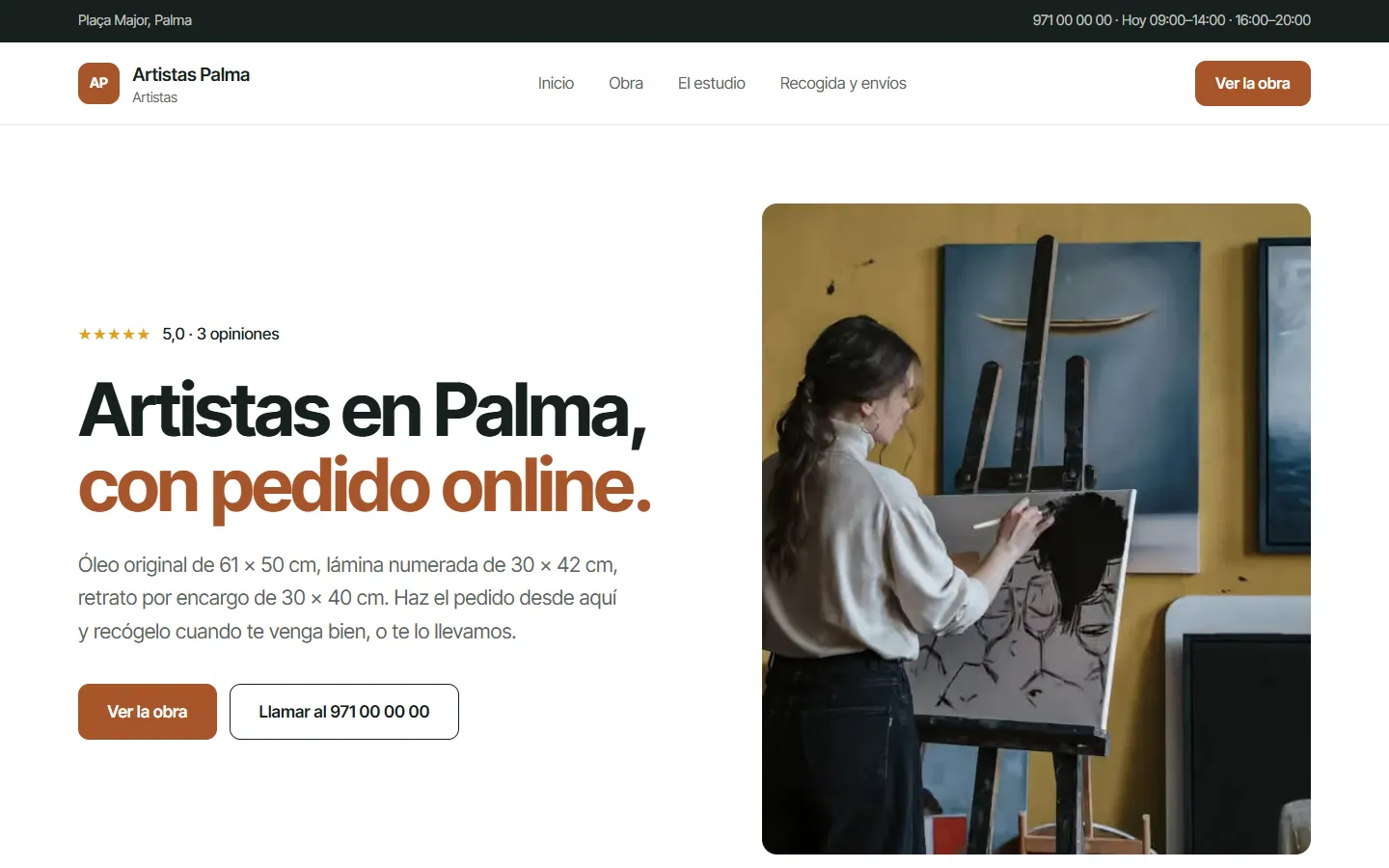
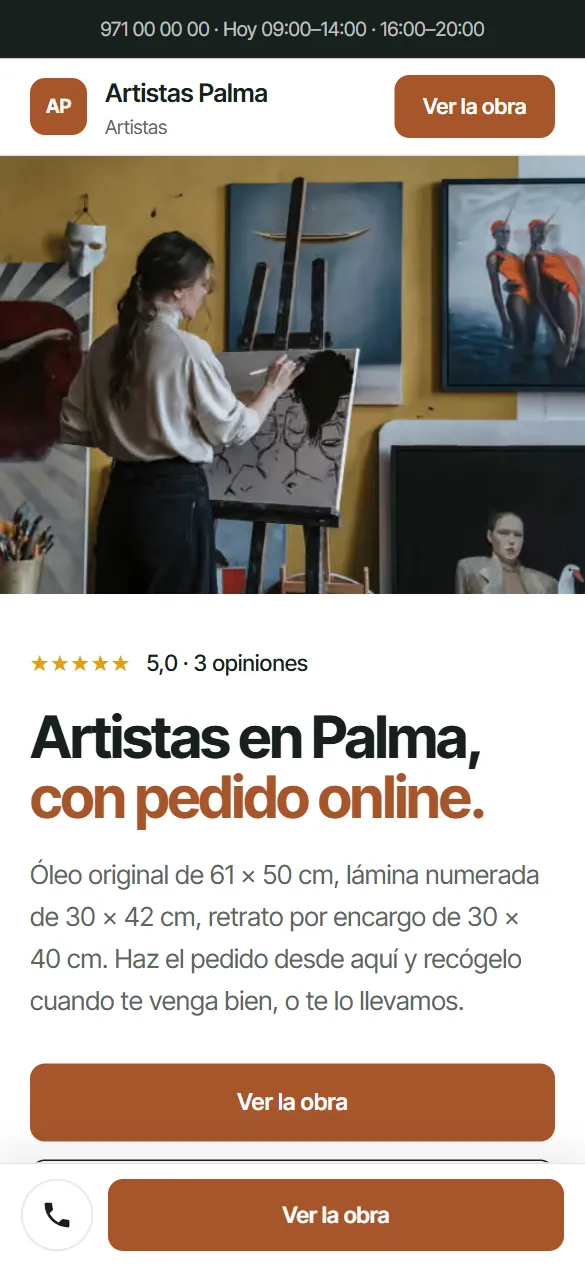
An artist is discovered at a fair, at an exhibition or through a shared post, and bought from later, at home. The website is where the work someone liked can be seen again with its details and ordered.
Each piece with title, medium, size, year and price. Just one unit for originals.
With the edition size, the paper and the signature, and the copies left.
What you accept, in which sizes and media, what the process is and how to request one.
A page for each series or medium, with the text that explains it.
Sketches, work in progress, the studio. What helps people understand the price of an original.
Where the work can be seen in person, with dates.
How a work travels, what it costs and whether it can be collected from the studio.
With their name and their website, so you can check. Translated from Spanish.
“We wanted a clean website to show our cars and make it easy for people to contact us. Agendra solved it for us with no hassle and no big costs.”
 Miguel Ángel GómezMAG Import Cars
These are not drawings: it is the sample website for artists, live right now, and you can switch design with one click without losing anything you have written.
Call it an online catalogue, a shop or an ordering system: for artists it is the same thing.
It works just the same if your business is called artist, fine art painter, illustrator, sculptor or visual artist: it is the same software and the same website.
You pick artists from the list, your website’s name and your phone number, and the website is created with what a business like yours offers (original oil painting, 61 × 50 cm, numbered print, 30 × 42 cm and commissioned portrait, 30 × 40 cm), which you replace with your own from the dashboard.
Thirty-six designs and your colour, with your artist website alongside while you choose. When you finish, it is already live.
Original oil painting, 61 × 50 cm and numbered print, 30 × 42 cm, each with its photo, price and stock, and the order placed from the website, with no commission per sale.
Anyone who visits an artist’s website wants to see work, not read a statement of intent. The home page has to show what you do in two seconds, and each piece has to open with its details.
Title, medium, size, year and price. Size matters more than it seems: people buy for a particular wall.
Each original has just one unit. As soon as it’s sold it stops being offered, and nobody pays for a piece that’s already in someone else’s home.
Giclée, screen print or etching, with the edition size in the description and as many units as copies left. It’s the way in for people who can’t afford an original.
A page for each series or medium, with its text. Someone looking for watercolours doesn’t have to go through the sculpture to find them.
A pet portrait, a mural for a restaurant, the illustration for a wedding invitation. Commissions are usually the steadiest part of the year, and they almost always start with the same conversation.
Sizes, media, rough lead times and whether you work from photos. In writing, it filters out the commissions that aren’t for you.
What they want, by when, in what size and with what rough budget. You choose the questions, and the request reaches your email and your phone.
If a portrait of a certain size has a fixed price, publish it as another listing: it’s ordered like any other work, and the details go in the order note.
Sketch, approval, lead times and when each part is paid. Explaining it beforehand removes the doubts that hold a commission back.
Instagram brings people in, but selling by private message is slow and gets lost halfway through the conversation. The website is where interest turns into an order, with the price and the details in plain view.
You pay the plan fee, and what you sell is yours. On a work costing hundreds of euros, a marketplace’s commission shows.
How you pack, what shipping costs and the amount above which it’s free. Someone buying from another city wants to know before ordering.
There’s no card payment when the order is placed: the buyer pays by Bizum (Spain’s instant bank-to-bank mobile payment) or bank transfer, or when collecting the work from your studio if they live in your city.
Fairs, markets and exhibitions on the blog, with their dates. Anyone who met you at one looks you up again before the next.
A portfolio shows; a shop sells. An artist needs both on the same website: the work with its details, the button to order it and a way to commission what doesn’t exist yet.
Originals, prints and fixed-price commissions, each with its own listing. And a page for each series for anyone looking for a particular medium.
The order reaches your email and your phone with the work, the buyer and whether they collect it or you ship it. No commission per sale.
You choose the questions: subject, size, medium, deadline and rough budget. You reply once, with everything in front of you.
Many of an artist’s sales start with a “how much is it?” in a private message, and many end there: the reply comes late, a detail is missing or the buyer cools off. With the work, its size and its price in plain view, whoever wants to buy, buys.
After a fair or a post that gets shared, people search for your name. If they land on your website and the work they saw is there with its price, the sale doesn’t depend on you replying in time.
Size, medium, deadline and rough budget on the form. Before replying you know whether the commission interests you and how long it will take.
You pay the fee, not a percentage of every work. On a piece costing hundreds of euros it’s the difference between what you charge and what you keep.
Nobody types “website” when they need artists: they ask Google about prices, urgency and trust. Answer that, and the website does the selling.
This is the dashboard of your artist website, with a full calendar.

Your website live at artistas.agendra.digital, with your products, your opening hours and your orders, with no card, for 6 months or until your first customer.
Your artist website with your own domain, on Google, with Agendra AI and marketing every week. Everything included and no commitment.
If you are torn between this, a custom-built artist website or sticking to social media: what each option costs and what it gives you.
Yes. Each original is a listing with a single unit, which stops being offered once it’s sold; each print is another listing with as many units as copies of the edition you have left. The same image in two sizes is two listings: within a listing there are no sizes or variants.
Through the contact form, which has the questions you choose — subject, size, medium, by when and rough budget. Every request reaches your email and arrives as a notification on your phone, and it’s saved in the dashboard, so you reply once and with everything in front of you.
Yes: each piece with its photo, its size, its price and a single unit, and the order straight to your email and your phone. It doesn’t take card payment at checkout: payment is agreed by Bizum, bank transfer or in person, which for work at a certain price is what many people prefer.
On fixed-price ones, yes, as another listing: a portrait in a particular size and medium. The ones that depend on each case, such as a mural, go through the form, and you give the quote once you know what it involves.
Yes. Each order can be collected from your studio or shipped, with the shipping cost you set and the amount above which it’s free. If a large or fragile work needs other transport, say so in its listing and it’s agreed separately with the buyer.
Yes. Some artists sell their large work through their gallery and their graphic work, commissions or small pieces on their website. It’s worth talking it over with the gallery and saying on your website where the work it represents can be seen: it avoids misunderstandings over prices and brings visits to both.
Yes, in the photo gallery and on the blog: sketches, layers, the studio, a work in progress. It’s what gets shared most and what helps people understand the price of an original. Photos are resized automatically when you upload them, so the website doesn’t slow down if you upload lots.
On a marketplace your work appears next to that of thousands of artists, with its commission and its rules, and the buyer belongs to the marketplace. On your website there’s only you, telling it your way and with no commission per sale. Many artists stay on the marketplace to be discovered and bring the people who already know them to their website.
Painting, illustration or sculpture: your available work with its size and price, prints with their edition and a clear way to ask you for a commission. So that anyone who discovers you at a fair or on Instagram can buy from you, with no middlemen.
Free until your first customer or 6 months · No card · No commitment · Live in minutes