


Your pieces
With a big photo, measurements, materials and price. And how many are left, if they are one-offs.
Ceramics, leather, soaps or basketry. Sell your work from your own website, without a platform taking fifteen per cent of every piece.
Free until your first customer or 6 months · No card · No commitment · Live in minutes
What people buy is the hand that made it. Telling the story of the process and showing the workshop sells more than any product description.
With a big photo, measurements, materials and price. And how many are left, if they are one-offs.
What can be made to order, with lead time and quote. It’s where the margin is.
The process, with photos of the workshop. It’s the reason someone pays more than in a shop.
Where they come from, whether they are local or recycled. It matters a lot to the people who buy from you.
How long it takes you to make a piece and to send it. Managing the wait is part of the deal.
Cost, delivery time and packaging. For fragile pieces, explaining how you pack them reassures people.
Where people can see you in person. It brings local traffic and direct sales.
With their name and their website, so you can check. Translated from Spanish.
“We wanted a clean website to show our cars and make it easy for people to contact us. Agendra solved it for us with no hassle and no big costs.”
 Miguel Ángel GómezMAG Import Cars
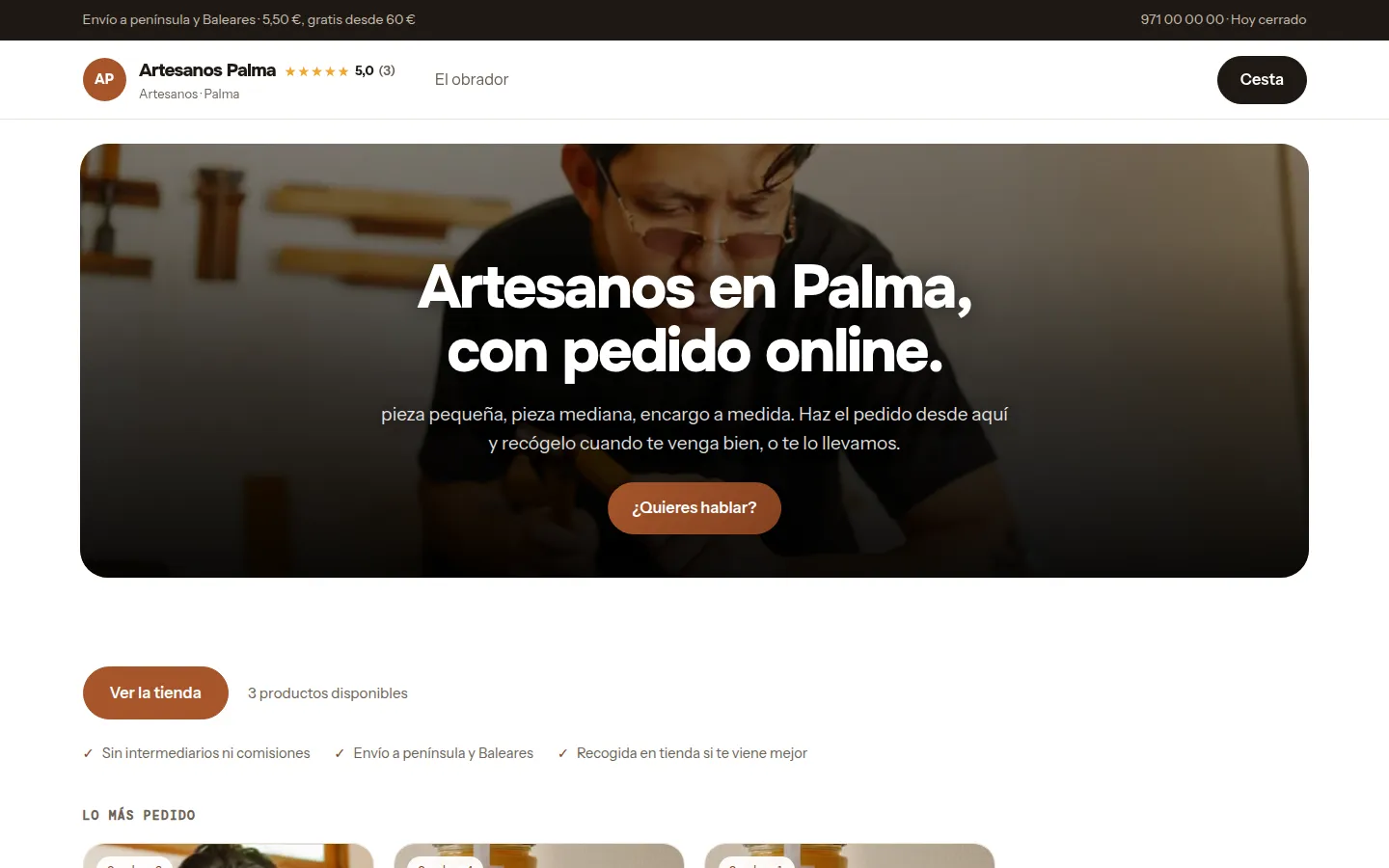
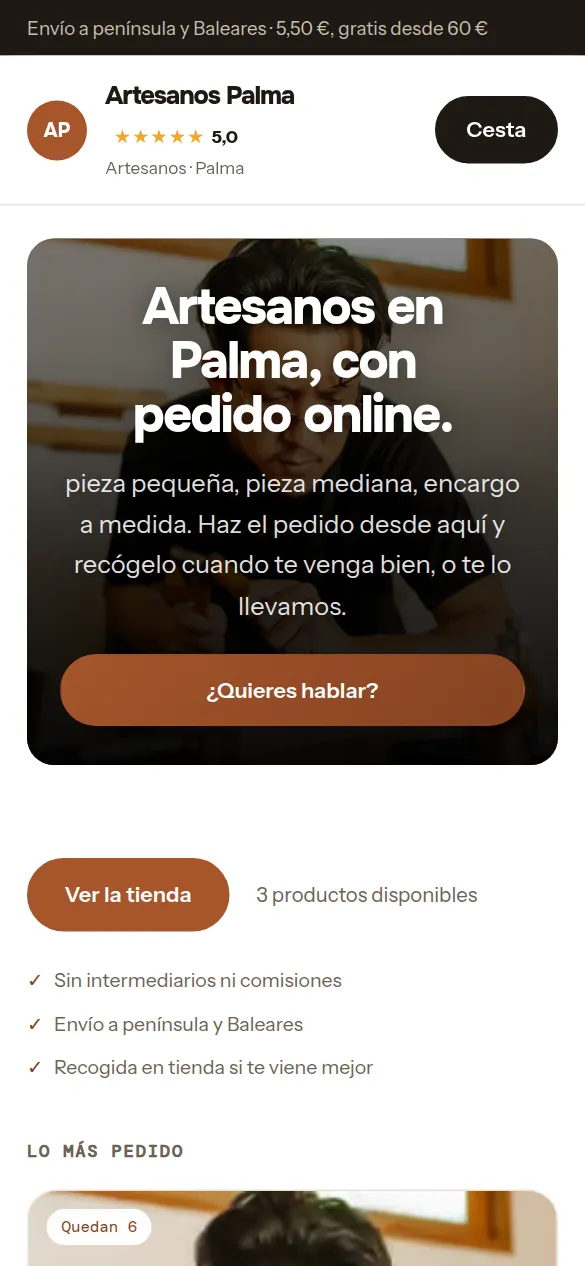
These are not drawings: it is the sample website for artisans, live right now, and you can switch design with one click without losing anything you have written.
Call it an online catalogue, a shop or an ordering system: for artisans it is the same thing.
You pick artisans from the list, your website’s name and your phone number, and the website is created with what a business like yours offers (small piece, medium piece and custom commission), which you replace with your own from the dashboard.
Thirty-six designs and your colour, with your craft shop website alongside while you choose. When you finish, it is already live.
Small piece and medium piece, each with its photo, price and stock, and the order placed from the website, with no commission per sale.
Craft marketplaces keep a commission on each sale plus another on each payment. On pieces of €30, that’s a lot of money over a year.
No commission per sale or per transaction.
People who discover you at a fair look for you by name, not in a marketplace’s internal search.
With one unit each: once sold, it disappears from the catalogue.
Photos of the workshop and of how the piece is made. It’s half the value.
As a service or with a form, because that’s where the margin is.
Where you’re going to be, on the blog, so people come looking for you there.
Selling on a craft marketplace is renting customers: you pay commission, you compete with a thousand others just like you and you don’t get anyone’s email. Your own shop changes all three.
Your pieces on your website, showing up on Google under your name and not the portal’s.
Your own form for things that aren’t in the catalogue. It’s where the big orders come from.
On pieces of €20 or €30, the portal’s commission is half your margin.
Before buying, people search for “handmade crafts near me”, and the winner is whoever shows price, photos and how to collect without making people ask. Your catalogue on your website, with orders coming straight to you and no middleman, is exactly that.
Someone searching “buy handmade crafts online with delivery” wants to know price and availability now. Your catalogue with photos and prices, on a website that is yours and not a marketplace.
Whatever sells out is marked automatically, and customers don’t ask about something you no longer have. For things that aren’t in the catalogue, there’s the WhatsApp button with the message already started.
Collection, delivery or both, however you work. The order arrives instantly and in the dashboard you see what stage each one is at, with no commission on sales.
Nobody types “website” when they need artisans: they type the problem, the price or the town. These are the searches your website has to answer.
This is the dashboard of your craft shop website, with a full calendar.

Your website live at artesanos.agendra.digital, with your products, your opening hours and your orders, with no card, for 6 months or until your first customer.
Your craft shop website with your own domain, on Google, with Agendra AI and marketing every week. Everything included and no commitment.
If you are torn between this, a custom-built craft shop website or sticking to social media: what each option costs and what it gives you.
Yes. Each piece is a product with a single unit; when it sells, it’s marked as sold out and is no longer offered.
No. You pay the plan fee, and everything you sell is yours.
Yes: each product with its photo, price and stock, orders reaching you instantly and each one in the dashboard. It doesn’t issue invoices or take card payments at checkout: you agree the payment yourself, on collection or by whatever method you already use.
Yes, with the contact form or by publishing the commission as a service with its starting price.
Yes, with the gallery and the blog. In crafts, the process is part of the product and what justifies the price.
Yes, with the blog or with a calendar page of its own. It’s what your regular customers check most.
On Etsy your work appears next to that of thousands of sellers, with the platform’s commissions and rules. On your website there’s only you: your story, your workshop and your catalogue, and you don’t pay commission on sales. It’s not one or the other: you can stay on Etsy and bring the people who already know you to your website, from Instagram, fairs or your business card.
Ceramics, leather, soaps or basketry. Sell your work from your own website, without a platform taking fifteen per cent of every piece.
Free until your first customer or 6 months · No card · No commitment · Live in minutes